Most enterprise AI pilots impress in the demo room. The agent answers questions about contracts and policies within seconds. Then the rollout begins, and trust erodes. The Finance team disputes over a number. The Legal questions a citation. The Operations team receives two different answers to the same request.
The cause sits in the data layer. Retrieval augmented generation, known as RAG, gives a language model a way to look things up. It works like a library card. The model can borrow any document it needs. But it cannot tell which document carries authority, or what a term means inside a given business unit.
What does enterprise reasoning demand?
Enterprise reasoning demands more than access to data. It demands shared meaning. A semantic data backbone supplies that meaning. It turns a clever assistant into a dependable decision partner.
Retrieval-Augmented Generation (RAG) lets AI search company documents. It uses the most relevant text to answer a question. This works well for simple lookups. However, RAG matches text by similarity and not by understanding. As a result, it can return answers that sound confident but are wrong.
A semantic data backbone solves this problem. It defines business terms once and applies them consistently. It captures how data connects, such as a supplier to a product and a product to a region. It also stores the rules, context and lineage behind each fact. Knowledge graphs and ontologies do much of this work.
With this foundation, AI can reason across systems. It can connect facts logically and answer complex questions that take several steps. The decisions become more trustworthy and easier to explain.
In short, RAG helps AI find information. A semantic backbone helps AI understand it.
What RAG does well and where it stops giving results?
A store runs a flash sale on a bestselling jacket. The system shows forty units in stock. Thousands of customers see the offer within an hour.
By midafternoon, only twelve jackets have sold. The other twenty-eight are still in the store, just in the wrong place. A stock count days earlier moved them to a back room, and they never made it back to the shelf.
The CCTV cameras recorded this. Staff walk past that back room shelf several times that day. But nobody is watching for a misplaced jacket. CCTV is there for shoplifting and safety, not inventory. It was never connected to the stock system, so the empty shelf and the full back room never get linked.
Customers show up expecting a jacket that technically exists but can't be found. The refund requests start within the hour.>
What RAG does well and where it stops giving results?
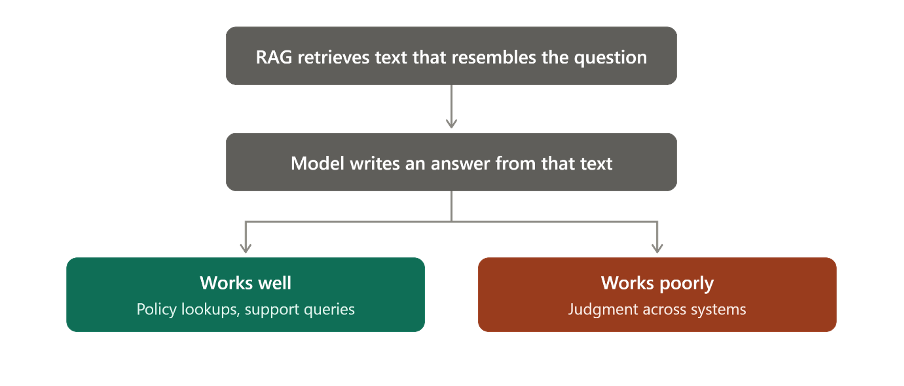
RAG retrieves text that resembles a question. A model then writes an answer from that text. This works well for policy lookups and support queries. It works poorly when a question demands judgment across systems.
Consider a simple request. A CFO asks which cu stomers face revenue risk because a supplier delayed a component. The answer sits across four separate systems. Similarity search returns fragments from each one. It cannot tell which fragments describe the same customer. It cannot tell which contract clause governs which shipment. The model fills the gaps with a guess.
That guess is the real cost of RAG in the enterprise. A confident but wrong answer in a pilot is an annoyance. The same answer inside an autonomous workflow is a business risk. Leaders who approve agent budgets now ask a sharper question. They ask whether the agent can prove its answer.
Why reasoning breaks without shared meaning?
Three structural gaps explain most agent failures in production.
- Ambiguous terms
The word customer means one thing in billing and another in sales. A model that retrieves both definitions has no basis to choose between them. Each department then receives a different answer to the same question.
- Lost relationships
Chunking splits documents into fragments. The links between a contract, a supplier and a delivery date vanish in that split. Reasoning depends on those links.
- Missing rules
Agents must follow policy. Text similarity cannot enforce a credit limit or a regulatory threshold. Rules need a structured home.
Better prompts and larger context windows do not fix these gaps. They add more text to a system that lacks structure. Enterprises need a layer that tells agents what the data means.
What is a semantic data backbone?
A semantic data backbone is a governed layer that encodes what enterprise data means. It maps each business entity to its relationships. It attaches definitions and rules to both. Every agent then reads from one shared model of the business.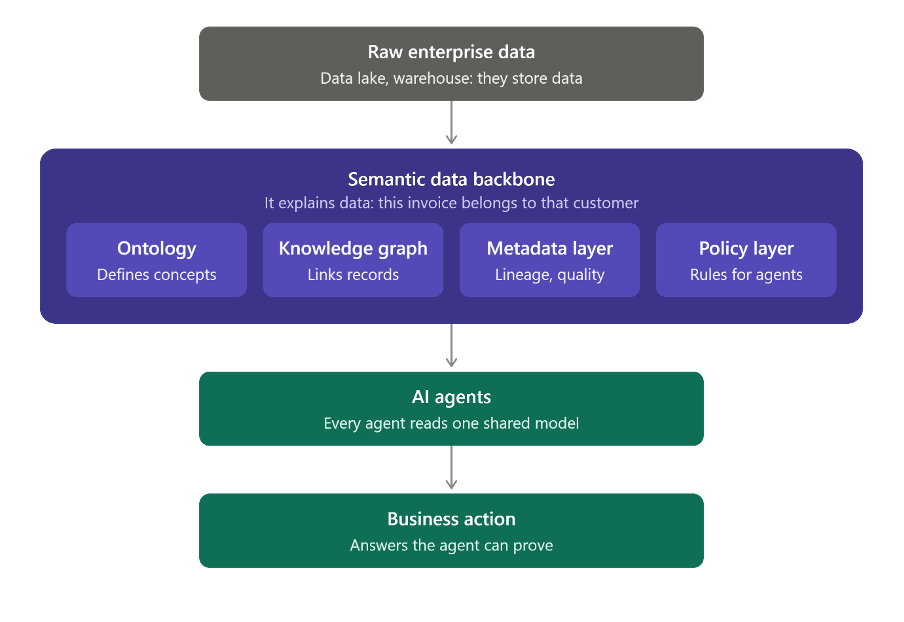
The backbone rests on four working parts. An ontology defines the concepts of the business. A knowledge graph connects real records to those concepts. A metadata layer tracks lineage and quality. A policy layer holds the rules that agents must respect.
This layer differs from a data lake or a data warehouse. Those systems store data. The backbone explains data. It tells an agent that this invoice belongs to that customer under this contract. The flow below shows where the backbone sits between raw data and business action.
How does a semantic data backbone change AI agent behavior?
An agent equipped with a semantic backbone reasons in four deliberate steps. First, it queries the knowledge graph to understand the structure of the business, treating a linked customer, contract and shipment as a single connected object. Second, it retrieves unstructured evidence, such as emails and contract clauses, for that specific object. Third, it forms a proposed action based on what it has found. Finally, it checks that action against the policy layer before anything is carried out.
This pattern is commonly known as GraphRAG. Because the agent already knows where to look, it searches with precision instead of relying on surface similarity.
Consider how this changes the CFO's question. The agent resolves each customer to a single identity and follows the graph from the delayed component to the affected orders and their contract terms. It then ranks the exposure by revenue and penalty clauses. The CFO receives a ranked list with sources attached, and the finance team can verify every line.
The backbone also gives leaders a reliable control point. When a definition is updated once, every agent inherits the change automatically. Auditors can trace any decision back to its source data and to the rule that applied. In this way, trust becomes a property of the architecture rather than a matter of hope.
Semantic data backbone outcomes by industry
The value of a semantic data backbone shows most clearly in regulated and complex sectors.
Banking: A know-your-customer agent must connect accounts, owners and transaction flows into one coherent picture. A graph exposes layered ownership structures that keyword search would miss. The agent flags the risk and cites the specific rule it applied. As a result, analysts spend their time on judgment instead of assembling data.
Manufacturing: A supply chain agent must link parts to suppliers and to open orders. When a supplier fails, the backbone shows which products and customers face exposure. The agent can then propose a reroute within minutes. This way, planners can approve a decision rather than build the analysis themselves.
Healthcare and life sciences: Clinical and regulatory teams tend to use different vocabularies for the same concepts. A shared semantic model aligns trial records with regulatory requirements. Agents can then draft submissions that reference approved definitions. Consequently, review cycles become shorter because reviewers trust the lineage behind each statement.
Insurance: Claims agents must read policy terms, coverage limits and customer history together. The backbone ties those records into a single view. As a result, Agents can settle simple claims faster, and route complex claims to the right adjuster with full context attached.
How can leaders start building a semantic data backbone?
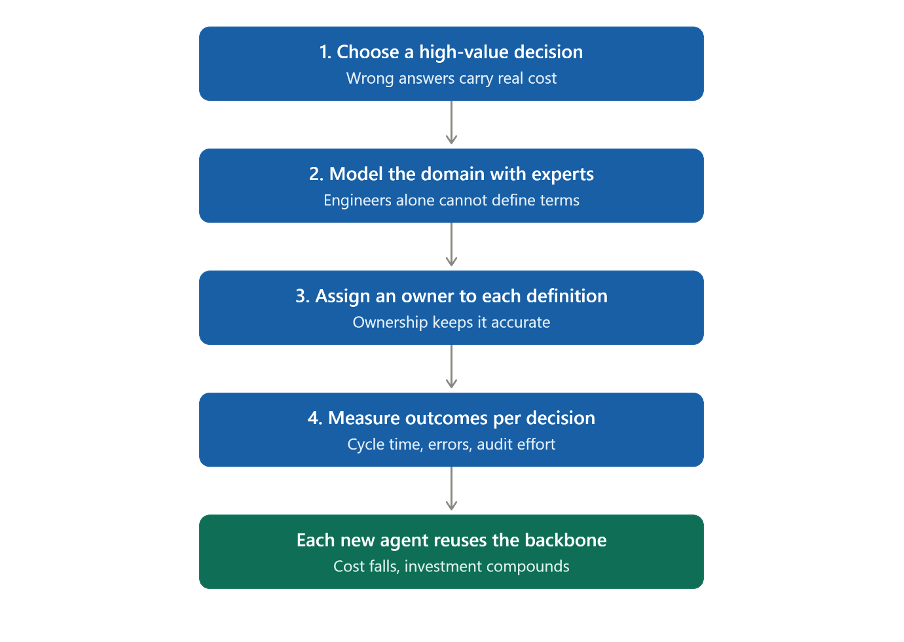
Leaders can start with one decision and grow the backbone from there.
1. Choose a high-value decision. Pick a workflow where a wrong answer carries a real cost.
2. Model the domain with business experts. Engineers alone cannot define what business terms mean.
3. Assign an owner to each definition. Ownership keeps the model accurate.
4. Measure outcomes per decision. Track cycle time, errors and audit effort.
Each new agent then reuses the backbone, so the cost of every later use case falls.
How Covasant leads on enterprise reasoning
Covasant helps enterprises build agentic AI that works in production. Our teams start with the semantic layer. We model the business domain with client experts. We connect that model to live systems. We then build agents that reason over it and act within governed limits.
Covasant treats the backbone as shared infrastructure. One backbone serves many agents. Each new use case moves faster because meaning already exists. Governance sits inside the design. Every agent decision traces back to its source data and the rule that applied.
We build that foundation with our clients and stay accountable.