Co-built. Co-deployed.
Engineering at the edge of your enterprise.
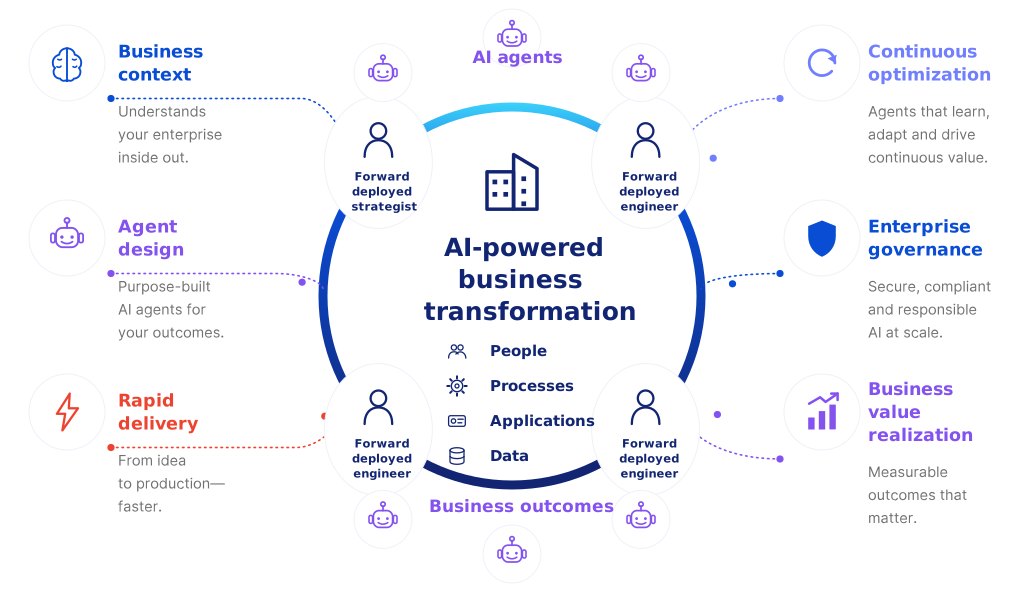
Covasant Forward Deployed Engineers (FDEs) embed inside your enterprise, immersed in your process, shaping agents that learn it and run it in production.
Accelerating Al agentification. Delivering business value.
Embedded experts who transform enterprise knowledge into Al agents that create measurable business outcomes.
Revenue
Growth
Operational
Efficiency
Faster
Decisions
Customer
Experience
Intelligent
Automation
AI at
Scale
We build beside you.
SERAA Cortex gives you the infrastructure to build, govern, and scale AI agents. SERAA Axon turns your data into something that an agent can reason over. A Forward Deployed Engineer carries both into your environment, learns how your operations actually work, and ships the first agent that solves the problems that matters to your business. This is what Covasant means by Services-as-Software: a team delivering on the Covasant SERAA platform.
Get FDEs that know your business.
A forward deployed engineer builds one feature for everyone. Your pod builds many things for you alone, sitting close enough to your operations to understand them the way your own people do.
Get working
systems.
Agents built on SERAA Cortex, your data connected through SERAA Axon, and a working system in production. The FDE that scopes your work is the one that builds it.
Get economics that improve
with scale.
Every pattern solved in your enterprise becomes an accelerator that stays in your SERAA Cortex estate. Your second agent costs less than your first, and the curve keeps falling from one agent to a hundred.
Why Forward Deployed Engineers?
- Deep business context and domain expertise
- Embedded Al and agent engineering expertise
- Continuous agent evolution and optimization
- Measurable business outcomes and ROI

Each deployment costs less than the last.
These reflect the SERAA Cortex delivery model. Your numbers depend on your use cases and your data readiness. Through continuous learning, FDEs are able to get it right the first time, every time.
From kick-off to a first agent in production
Faster to build than starting from scratch
Enterprise connectors available out of the box
Your data stays within your perimeter
Everything that a successful deployment needs, in one FDE pod.
Covasant deploys in tight pods rather than large mixed crews. Engineers who build are paired with people who know your industry and your governance obligations. The same shape scales from a single proof of value to an enterprise estate.
Forward Deployed Engineer
Builds and deploys agents in Agent Studio, integrates data through SERAA Axon, clears each agent through the AgentEval gate, and wires multi-agent orchestration workflows in OrchestratAI.
Deployment Strategist
Maps and sequences your use cases in StrategyCompass by business impact, and works through the adoption and stakeholder questions that decide whether an agent reaches production or not.
Domain Specialist
Brings the context of your sector, banking, healthcare, manufacturing and others, so agents are built on the right ontologies and rules from the start rather than corrected later.
Governance Lead
Owns the Agent Registry record and the audit trail. Every agent clears its PII and data residency checks, with the role-based access controls and decision-tracing, much needed for governance.
We build and then hand it over to you.
Prove one high-value use case in production. Extend across functions, reusing what was built. Then, transfer the capability so that your team owns it. The effort per deployment falls as accelerators accumulate, and that falling curve is the evidence you are buying software, not consulting hours.
Ship the first agent
A focused, paid deployment on one priority use case, scoped in StrategyCompass and put into governed production.
Measure real impact
The agent runs live under AI Agent Control Tower oversight, measured against a baseline that you agree to up front.
Reuse and extend
Adjacent functions come next, reusing SERAA Cortex accelerators so that each agent costs less to build than the one before.
Hand over the keys
We train your engineers, hand over the registry and the running estate, and move to an on-call support.
The test we hold ourselves to is simple. After the FDE pod steps back, your organization can still build, govern, and run its agents without us.
Questions that enterprise leaders ask us
If yours is not here, then our FDE team will answer it directly.
When should a company use a Forward Deployed Engineer instead of its own team?
Use a Forward Deployed Engineer when your platform is bought, but idle; when your internal team lacks production AI deployment experience, or when the first use case crosses messy legacy systems. If the work is routine and your team has shipped similar integrations before, then in-house is cheaper. The FDE earns its cost on the hard, first-of-its-kind deployment.
What problems does a Forward Deployed Engineer solve?
A Forward Deployed Engineer solves the last-mile problem: the gap between an AI demo that works on sample data and a system that runs on live enterprise data under real governance. They handle integration with legacy systems, data plumbing, security review, and the edge cases that kill pilots after the proof of concept.
Do Forward Deployed Engineers only matter for AI, or for any software?
Forward Deployed Engineers predate AI and work for any complex software that needs heavy customization to fit a customer's environment. Palantir built the model around data platforms years before the current AI wave. AI made the role urgent because the gap between a model demo and a production system is unusually wide.
What is the difference between a Forward Deployed Engineer and a consultant?
A consultant delivers a recommendation. A Forward Deployed Engineer delivers a running system. Consultants analyze and advise, and then leave a report. FDEs write production code inside the customer's environment and stay until it works. The simplest difference: a consultant hands you a plan, an FDE hands you software that runs.
Do Forward Deployed Engineers work on-site or remotely?
Both. On-site was the original model, borrowed from military deployment, and defense or consulting FDEs may still be on-site several days a week. AI-era FDEs are often hybrid or remote, working inside the customer's cloud environment through controlled access. What matters is working inside the customer's systems, not physical location.
Why are Forward Deployed Engineers suddenly in demand?
Demand for Forward Deployed Engineers increased because enterprises bought AI capability faster than they could deploy it. Models became easy to access. Getting them running inside messy enterprise systems did not. Postings for the role climbed sharply through 2025 and 2026 as companies hit the same wall: the demo closed the deal, but production never arrived.
Can a Forward Deployed Engineer help if we already bought an AI platform?
Yes, and that is the most common case. Buying a platform rarely gets an agent into production on its own. The platform assumes engineering capacity most teams do not have spare. A Forward Deployed Engineer builds the first live use case on the platform that you already own, and then, leaves your team fully able to build the next.
Are Forward Deployed Engineers worth it?
Forward Deployed Engineers are worth it when the cost of a stalled deployment is higher than the cost of the engineer, which is usually the case for complex enterprise systems. They pay off by turning a bought-but-idle platform into a running system within weeks, closing the gap where most AI spend is otherwise lost.
Turning enterprise knowledge into autonomous outcomes.
Let us show you how a Covasant Forward Deployed Engineer would take you from where you are today to a governed system running in production.