Signal arrives as a candidate
What Pulze captures in meetings and market feeds does not become knowledge automatically. It enters the governance queue and waits for a reviewer.
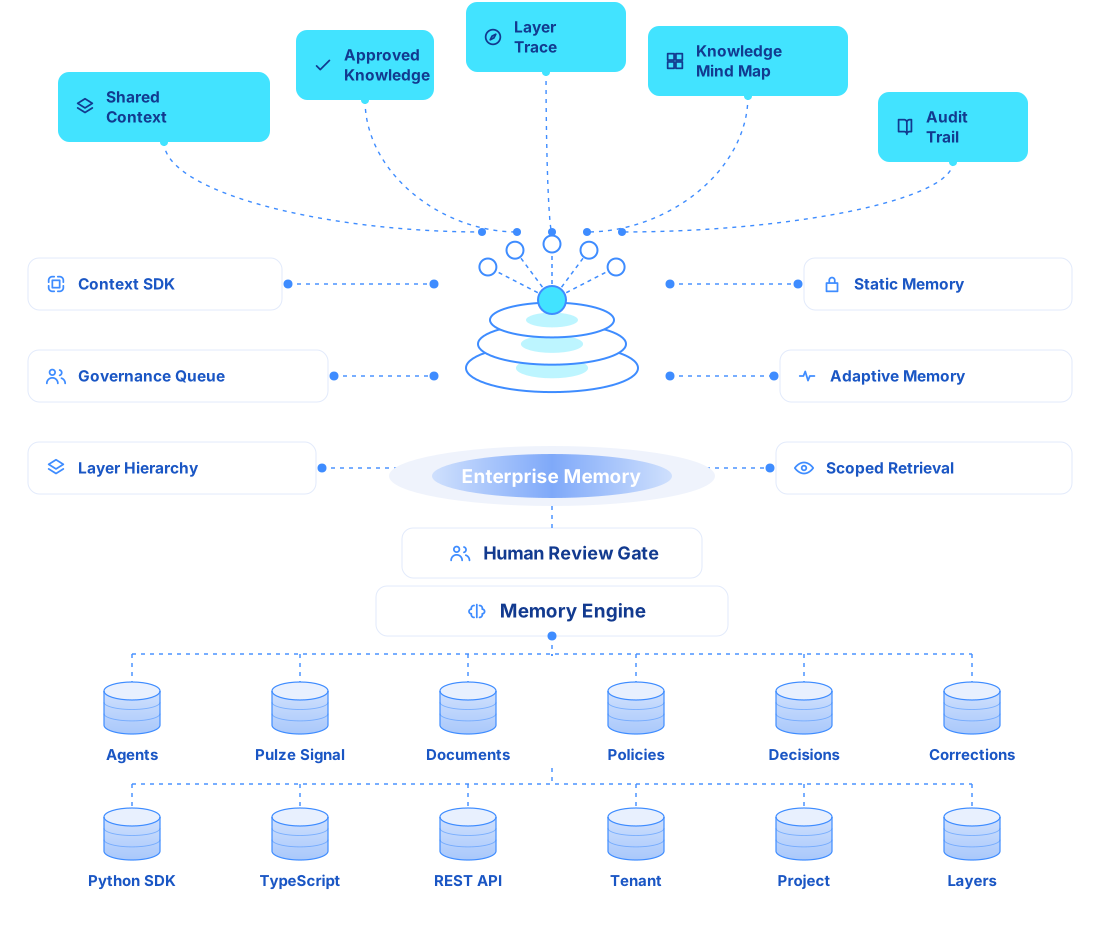
Synapse is hierarchical memory infrastructure for enterprise AI. It gives every tenant a Layer hierarchy that mirrors their real structure, and puts a human between "the AI noticed something" and "this is now shared knowledge." Every agent that writes context in improves performance for every agent that follows.
Observed 14× across 9 distinct branch users during live customer onboarding.
The default architecture for agent memory is a vector store: one flat index, everything in it, similarity search over the lot. It works in a demo. In an enterprise it fails in two specific ways.
One region's local exception, one team's workaround, one deprecated policy — a flat index cannot tell them apart, so they surface in answers where they do not belong.
Vector LeakageIf whatever the model inferred becomes memory automatically, your shared knowledge base is a record of the model's guesses, compounding quietly.
Unvetted GuessesRetrieval cannot be scoped to a branch of the organisation that the memory does not model, so precision degrades as the corpus grows.
Unscoped PrecisionWithout portable context, each agent's understanding dies with its session, and the fiftieth agent is exactly as ignorant as the first.
Ephemeral ContextRetrieval is scoped to a Layer path, so one branch's local exception cannot leak into another branch's answers. The structure is defined by the tenant, because only the tenant knows how their organisation actually works.
Tenant-defined Layers: Tenant → Project → Enterprise Memory → Layers. Retrieval is scoped to a Layer path, so one branch's local exception cannot leak into another region's answers. This is the structural difference from a flat vector store, and it is the reason precision holds as the corpus grows rather than degrading.
Two kinds of memory coexist. Static memory is what the enterprise has decided is true — policy, structure, definitions. Adaptive memory is what the system has observed working in practice. Keeping them distinct means you can trust the first and interrogate the second, rather than blending them into one undifferentiated soup.
The system proposes: it notices a pattern, an exception, a correction that appears to hold. A reviewer accepts or rejects. Only accepted candidates are promoted into shared knowledge. This is the single most important design decision in the product — memory that writes itself is a liability in a regulated enterprise.
Self-service portal, a playground with full Layer trace, a governance queue for pending promotions, a click-to-explore Mind Map of what is known, and an audit trail scoped to a single Enterprise Memory. Python and TypeScript SDKs are live today.
Pulze sells a function a number. Axon sells a data estate its truth. Cortex sells a platform team its control plane. All three are tools businesses — good ones. Synapse is different.
Tenant → Project → Memory
Python & TypeScript
Human approval
Click to explore
Synapse is the earliest-stage product in the portfolio. It is in alpha, the first customer pilot is targeting September 2026, and it sits outside Q1 partner scope in Horizon 2. The Context SDK is live today and you can build against it now. We are not going to describe it as production-ready, because it is not — and the whole point of this component is that unvetted claims do not get promoted to truth.
An agent that contributes context makes the next agent better, and the one after that. The value of the memory is a function of how much has flowed through it, which no competitor can replicate by shipping a feature.
What builds up is not our model weights — it is your approved organisational knowledge, structured and scoped. Migrating away means abandoning it, which is the definition of a moat that is not built on lock-in tricks.
Four products that share nothing are a portfolio. Four that share governed context are a platform. Synapse is the shared context, which is why it is load-bearing even though it is the earliest-stage product.
What Pulze captures in meetings and market feeds does not become knowledge automatically. It enters the governance queue and waits for a reviewer.
Memory carries organisational understanding; Axon carries mastered data. Together an answer is both contextually aware and factually grounded.
Agents built in the Work Bench read the same scoped memory, so behaviour is consistent across the estate rather than per-agent folklore.

Signal your systems never recorded.
Explore Pulze →Reasoning across everything you own.
Explore Axon →Memory with a human in the loop.
The operating system for agents.
Explore Cortex →The Context SDK is live in Python and TypeScript. If hierarchical, human-approved memory is the thing your agent estate is missing, we are taking a small number of pilot customers.