Nothing becomes company knowledge until a person says so.

A flat vector store is not an enterprise memory. 

SERAA Synapse is hierarchical memory infrastructure for enterprise AI. It gives every tenant a Layer hierarchy that mirrors their real structure, and puts a human between "the AI noticed something" and "this is now shared knowledge." Every agent that writes context in improves performance for every agent that follows.

SERAA Synapse: Knowledge climbs one layer at a time
Platform Engineering
KNOWLEDGE PROMOTION

Human review gate before insight becomes shared policy.

 
Layer 1 · Corporate Policy
Global rules true across every department & region.
Static
 
Layer 2 · Regional Playbook
Regional procedures & approved compliance flows.
Static
 
Layer 3 · Branch Procedures
Real-time frontline conversations & team patterns.
Adaptive
PENDING PROMOTION · L3 → L2

Route EU-domiciled onboarding to legal before KYC.

Observed 14× across 9 distinct branch users during live customer onboarding.

 
Review gate logged · Human-in-the-loop validation attached.


AlphaFirst customer pilot targeting Sept 2026
2 SDKsPython and TypeScript, live today
1 humanReviews every promotion to shared knowledge
Tenant → LayerHierarchy that mirrors your org
01 — The problem

Agents that start from zero, every single time.

The default architecture for agent memory is a vector store: one flat index, everything in it, similarity search over the lot. It works in a demo. In an enterprise it fails in two specific ways.

PROBLEM 01

Everything leaks everywhere

One region's local exception, one team's workaround, one deprecated policy, a flat index cannot tell them apart, so they surface in answers where they do not belong.

Vector Leakage
PROBLEM 02

Nobody vetted any of it

If whatever the model inferred becomes memory automatically, your shared knowledge base is a record of the model's guesses, compounding quietly.

Unvetted Guesses
PROBLEM 03

No structure to scope to

Retrieval cannot be scoped to a branch of the organisation that the memory does not model, so precision degrades as the corpus grows.

Unscoped Precision
PROBLEM 04

Every agent relearns

Without portable context, each agent's understanding dies with its session, and the fiftieth agent is exactly as ignorant as the first.

Ephemeral Context
02 — A hierarchy, not an index

Tenant → Project → Enterprise Memory → Layers.

Retrieval is scoped to a Layer path, so one branch's local exception cannot leak into another branch's answers. The structure is defined by the tenant, because only the tenant knows how their organisation actually works.

01

A hierarchy, not an index

Tenant-defined Layers: Tenant → Project → Enterprise Memory → Layers. Retrieval is scoped to a Layer path, so one branch's local exception cannot leak into another region's answers. This is the structural difference from a flat vector store, and it is the reason precision holds as the corpus grows rather than degrading.

02

Static plus adaptive

Two kinds of memory coexist. Static memory is what the enterprise has decided is true, policy, structure, definitions. Adaptive memory is what the system has observed working in practice. Keeping them distinct means you can trust the first and interrogate the second, rather than blending them into one undifferentiated soup.

03

The learning loop, with a person in it

The system proposes: it notices a pattern, an exception, a correction that appears to hold. A reviewer accepts or rejects. Only accepted candidates are promoted into shared knowledge. This is the single most important design decision in the product, memory that writes itself is a liability in a regulated enterprise.

04

A platform, not a library

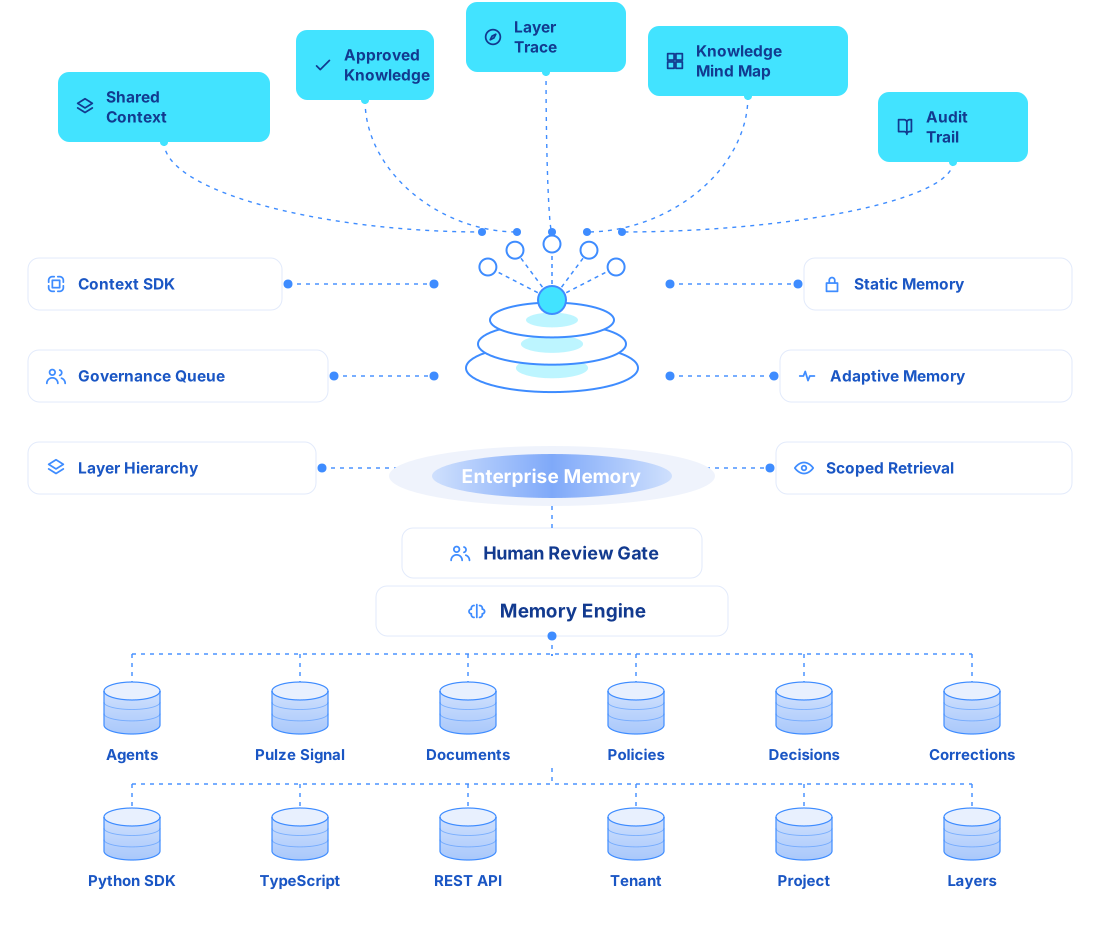
Self-service portal, a playground with full Layer trace, a governance queue for pending promotions, a click-to-explore Mind Map of what is known, and an audit trail scoped to a single Enterprise Memory. Python and TypeScript SDKs are live today.

The only component that behaves
like a platform business.

SERAA Pulze sells a function a number. SERAA Axon sells a data estate its truth. SERAA Cortex sells a platform team its control plane. All three are tools. SERAA Synapse is different.

Layer hierarchy

Tenant → Project → Memory

Context SDK

Python & TypeScript

Governance queue

Human approval

Knowledge Mind Map

Click to explore

Stage, stated plainly

SERAA Synapse is the earliest-stage product in the portfolio. It is in alpha, the first customer pilot is targeting September 2026, and it sits outside Q1 partner scope in Horizon 2. The Context SDK is live today and you can build against it now. We are not going to describe it as production-ready, because it is not, and the whole point of this component is that unvetted claims do not get promoted to truth.

It is what makes the platform claim true

Four products that share nothing are a portfolio. Four that share governed context are a platform. Synapse is the shared context, which is why it is load-bearing even though it is the earliest-stage product.

Memory sits under everything
that acts.

SENSE · LIVE SIGNAL
CAPTURED Meeting stream
"Market signal EMEA Q3..."
↓
Field note · APACQUEUED
Competitor mentionQUEUED
Governance queue 3 awaiting review
 
NOT YET KNOWLEDGEREVIEWER PENDING
FROM SERAA PULZE

Signal arrives as a candidate

What SERAA Pulze captures in meetings and market feeds does not become knowledge automatically. It enters the governance queue and waits for a reviewer.

EVALUATE · REASONING
SERAA SynapseOrg understanding
+
SERAA AxonMastered data
SQL + Vector + Graph
ONE CHAIN Audit attached
 
↓
Customer · ACME-04GOLDEN
Contract valueGOLDEN
CONTEXTUALLY AWAREFACTUALLY GROUNDED
WITH SERAA AXON

Grounded against Golden Records

Memory carries organisational understanding; Axon carries mastered data. Together an answer is both contextually aware and factually grounded.

ACT · CONTROL PLANE
  4 Agents Active
Scoped memory READ
EMEA-UK · Project layer
↓
Agent · RenewalsSYNCED
Agent · OnboardingSYNCED
Agent · SupportSYNCED
Task Tree #8402 ACTIVE
Kill switch engaged
ONE BEHAVIOURNO PER-AGENT FOLKLORE
FOR SERAA CORTEX

Agents read before they act

Agents built in the Work Bench read the same scoped memory, so behaviour is consistent across the estate rather than per-agent folklore.

SERAA Synapse Architecture Diagram

The platform, deployed by the people who built it.

Forward-deployed engineers and strategists embed with your team, stand Covasant SERAA up inside your perimeter, and prove the first workflow. Then they hand it over.

Straight answers on governing, promoting, costing and stopping AI agents.

SERAA Synapse is the Remember layer of the Covasant's SERAA platform, a governed enterprise memory that agents read from and write into. Nothing becomes company knowledge until a person approves it. It holds knowledge as a hierarchy the tenant defines rather than as a flat index, and retrieval is scoped to a layer path so an answer is assembled from the altitudes that apply to whoever is asking.
A flat vector store is not an enterprise memory, because enterprises are not flat and their knowledge sits at different altitudes: corporate policy, a regional playbook and a branch procedure are three different altitudes of truth. A flat index either returns all three as equally weighted noise or needs manual filtering maintained forever. SERAA Synapse holds those altitudes as explicit layers the tenant defines, and scopes retrieval to a layer path. Good vector databases do what they do well. A flat index is simply the wrong altitude for governed enterprise knowledge.
Memory in SERAA Synapse has four levels: a tenant holds projects, a project groups related Enterprise Memories, an Enterprise Memory covers one knowledge domain, and the layers inside it are defined by the tenant. You choose how many layers there are and what they are called, in your own language, whether that is two or five. Retrieval is scoped to a layer path, so an answer is assembled from the altitudes that apply to whoever is asking.
SERAA Synapse has two kinds of layer: static layers hold the documents you upload, indexed immediately and each scoped to exactly one layer in the hierarchy, while adaptive layers hold patterns mined from real conversations and queries at the most specific layer. Adaptive layers are where the workarounds and edge cases nobody writes down get caught. Detection requires recurrence across enough distinct people and sessions, so one conversation does not become a pattern.
In SERAA Synapse the loop is observe, detect, review, promote, record, and a person sits in the middle of it. A reviewer sees the exact text that would be written into memory, never a paraphrase of it, and can edit it, approve it or reject it. Approved knowledge climbs one layer at a time, branch then region then corporate, accumulating evidence at each gate, so one site’s experience cannot become company policy by accident. Promotion policy is set per tenant, and regulated buyers typically keep review switched on for the top layers while auto-promoting at the bottom.
Yes. Anything promoted in SERAA Synapse can be demoted afterwards, and the reason for the demotion is recorded in the audit trail alongside it. The governance queue tracks pending, promoted and rejected items together with demotions, and the audit trail keeps the full history visible to the tenant. That matters because a policy that was true last year and is wrong now is a more common problem than a fact that was never true.
SERAA Synapse exposes the trace rather than only the answer: the Playground returns a full trace of which layers contributed to an answer, and the Mind Map is a click-to-explore view of a hierarchy and what produced each layer. The governance queue tracks pending, promoted and rejected items together with demotions, the audit trail keeps the full history visible to the tenant, and a usage dashboard sits alongside them. For a regulated reviewer the question is rarely only what the answer was. It is which altitude of truth it came from.
No. Retrieval in SERAA Synapse is scoped to a layer path, so an exception recorded at one branch is available to that branch and does not surface in another region’s answers unless it is promoted upward through review. Multi-tenant isolation is enforced at the data-access layer rather than in the interface. For deployment-specific isolation questions, our architects will walk your security team through it directly.
Yes. SERAA Synapse is designed to be written into and read from by agents that are not ours, which is the difference between portable memory and memory tied to one runtime. Integration runs through the Context SDK for Python and TypeScript, or through agent-framework plugins. API keys and SDK credentials are scoped to a single Enterprise Memory rather than to the whole tenant, so an integration cannot reach beyond the domain it was issued for.
Eleven industry templates ship with SERAA Synapse, each one a pre-built layer hierarchy with static and adaptive defaults already set. They cover healthcare for clinical decision support, financial services for wealth management, retail for customer service and sales, manufacturing for quality control, legal for contract review, education for personalized learning, insurance for claims and underwriting, pharmaceutical for drug development and trials, supply chain for logistics, human resources for talent management, and private equity for liquidity intelligence. Every template is editable after creation, and you can define your own hierarchy instead.
SERAA Synapse is the Remember position in the Covasant's SERAA loop of Sense, Evaluate, Remember, Act and Assure, and it is where knowledge a person has approved is kept. SERAA Pulze senses the signal that never reaches a system of record, SERAA Axon reasons across the systems you already run, SERAA Synapse holds what was approved as worth keeping, and SERAA Cortex runs the agents that act on it. Assure is not a fifth product. It is the governance layer all four run inside. SERAA Synapse is designed so that knowledge promoted in one place raises the quality of every agent that draws on it afterwards.
SERAA Axon is the reasoning layer and SERAA Synapse is the memory layer. SERAA Axon sits above the systems you already run, connects them into one semantic layer, and answers questions with the reasoning chain attached. SERAA Synapse holds what an enterprise has decided is worth remembering, in a hierarchy a person governs. One reasons over what you already store. The other decides what becomes knowledge in the first place.
Enterprise search and context platforms are genuinely strong at retrieval and at respecting permissions, and several of them are credible. What differs is what they are optimized for: most surface the right information while the action happens somewhere else, and their context is tuned for their own surface first. SERAA Synapse is built as a memory that other systems write into and read from, with a person in the promotion loop, so the knowledge ends up governed and portable rather than only findable.

Build against the SDK now. Pilot the platform next.

The Context SDK is live in Python and TypeScript. If hierarchical, human-approved memory is the thing your agent estate is missing, we are taking a small number of pilot customers.