Managed cloud
Fastest to value, operated by us. GKE, AKS or EKS in the region you choose, frontier models via Vertex AI, Bedrock or Azure AI Foundry.
Available
Covasant SERAA, the Agentic Enterprise Intelligence Platform, is the layer between the systems that you already run and the agents that you want acting on them. Four components, each a product in its own right, and one governance plane across all of them.
Each layer answers a question that the one before it cannot. Skip a layer and the agents downstream start guessing, which is precisely how pilots die between the demo and production.
Capture signal that never reaches a system of record, what was said in meetings, what the field learned, and market shifts.
Explore SERAA Pulze →Reason across every system at once, SQL, vector, graph, composed into one chain with full audit trail attached.
Explore SERAA Axon →Keep what worked, once a person has approved it. A hierarchy that mirrors your org, so that no agent starts from zero.
Explore SERAA Synapse →Build, orchestrate, register, and monitor every agent from one control plane, with a kill switch that works.
Explore SERAA Cortex →Answer for all of it. Scope-based access control runs across all four as architecture, not a module bolted onto one.
Detailed below ↓Each layer is a complete product on its own; one project, one budget, one result that you can point at. What makes them one platform is shared context, so that whatever you start with makes whatever you add next work better.
The operating system for your agents, and the memory that they carry between runs.
Unified data, a semantic model that your business recognizes, and answers on demand.
The signal from meetings and the market that never reaches a system of record.
Products do not need to share a runtime to be one platform. They need to share context, and that is the part that we do not compromise on. Whatever you buy first, what it learns, is available to whatever you add next: no migration, no re-implementation, no second contract. Start with one layer and you keep the option on the rest. Start with all four and none of the work is duplicated.
Scope-Based Access Control organizes every resource around three nested scopes that mirror how enterprises already operate. Assets flow up. Infrastructure flows down.
Governance is the layer across all four.
This is the claim that most platforms make and few can substantiate. Here is the specific mechanism, component by component.
SERAA Pulze feeds SERAA Synapse
Signal captured from meetings and market feeds does not stay in a sales tool. It lands in memory as a candidate, goes through review, and becomes knowledge that the rest of the estate can use.
SERAA Axon grounds everything above it
Golden Records are the trusted version of the truth that agents reason over. Without mastering, every downstream answer inherits the data quality of whichever system it happened to hit.
SERAA Synapse stops agents starting cold
SERAA Synapse is designed so that knowledge promoted in one place raises the quality of every agent that draws on it afterwards. Across products, that depends on a shared context contract which is not yet published.
SERAA Cortex is where it all executes
Agents built in the Agent Work Bench read the same memory, reason through the same layer, and run under the same policy, which is the difference between an agent estate and a collection of pilots.
Every agent orchestrates tools, retrieves verified knowledge from SERAA Synapse, and executes governed real-world actions with end-to-end tracing and predictable token costs across enterprise workloads.
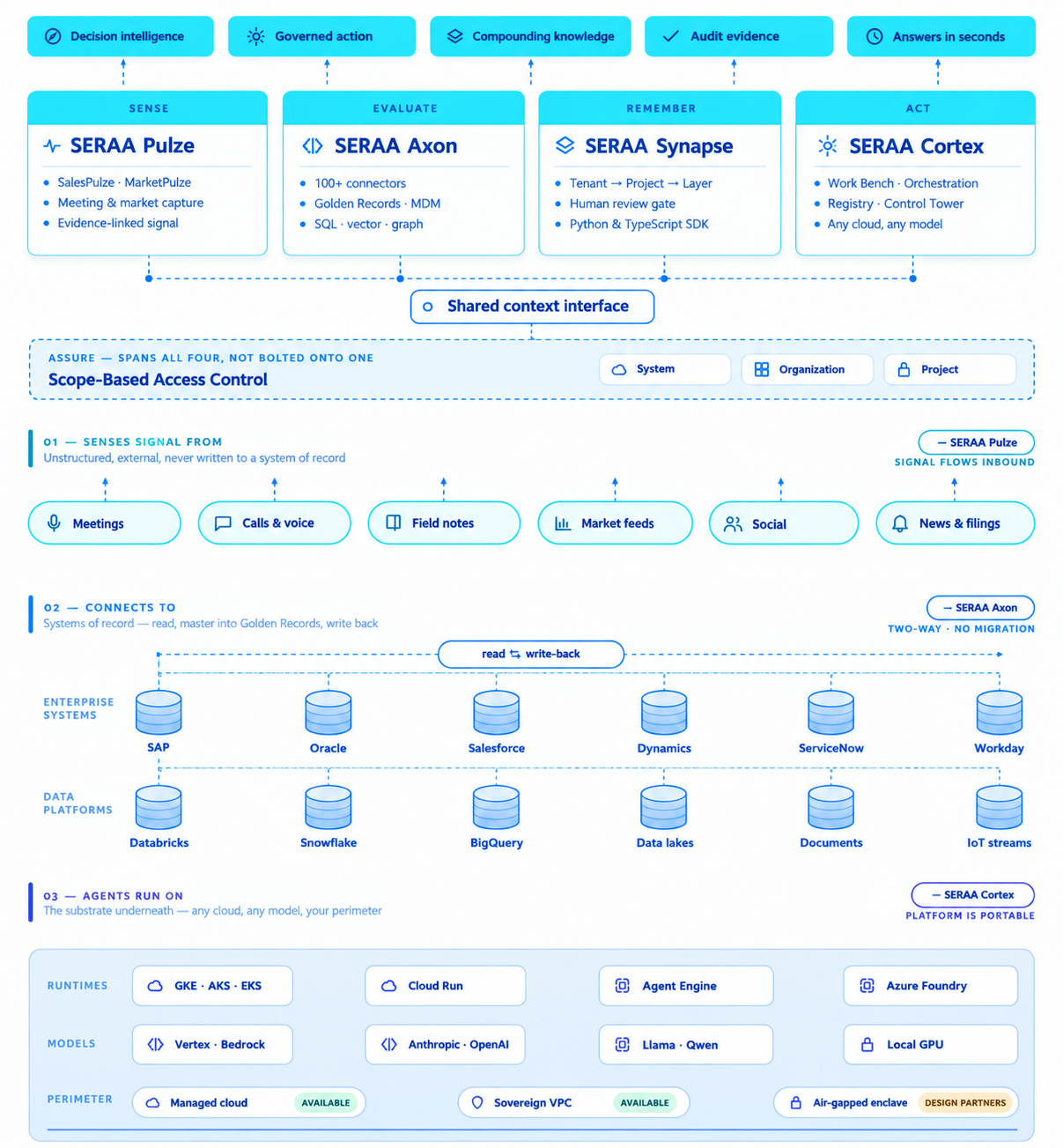
Regulated buyers should not have to choose between capability and custody. Covasant SERAA ships as software that you run.
Fastest to value, operated by us. GKE, AKS or EKS in the region you choose, frontier models via Vertex AI, Bedrock or Azure AI Foundry.
Single-tenant inside your perimeter. Dedicated per-customer VPC, your cloud account, your keys, your network policy. No shared control plane.
Open-weight models on your own GPUs, local vector store, mirrored registries inside the enclave. Every dependency pre-staged; updates by signed media.
Tiers 01 and 02 are running with customers today. Tier 03 is an engineering program. Air-gapped means every dependency is pre-staged inside the enclave, and we will not call it shipped until it is. Ask us what is built and what is not; we will show you the same table that we use internally.
Every model call goes through one provider-agnostic interface. Swap a frontier API for an open-weight model on your own hardware from configuration, the agents, policies, and audit trail do not change.
Vertex · Bedrock · Foundry · Anthropic · OpenAI
Llama · Qwen · Mistral
Managed, or FAISS self-hosted
GKE · AKS · EKS · Cloud Run · Agent Engine
Entra ID · GCP IAM · Cognito · local LDAP
Configuration, not code
Forward-deployed engineers and strategists embed with your team, stand Covasant SERAA up inside your perimeter, and prove the first workflow. Then they hand it over.
Bring to us one question that your data can't answer currently, or one agent estate that nobody can currently see. We'll tell you which of the five layers you actually need.