Model Context Protocol (MCP)
Every external tool integration is a standardised MCP server, which is what makes agent-to-service communication secure, auditable and extensible rather than bespoke per tool.
CAMS is now SERAA Cortex. The Covasant Agent Management Suite has joined the Covasant SERAA platform. Same product, same roadmap, one name, existing contracts, APIs and deployments are unaffected.
SERAA Cortex is the agent operating system for the enterprise agent lifecycle: build, orchestrate, register, and monitor. Vendor-neutral by design, it governs agents that you built here alongside agents built in Gemini, Azure, AWS or Databricks, without fragmentation and without lock-in.
| Agent | Runtime | Model | Status |
|---|---|---|---|
|
kyc-doc-verifier
|
GKE · us-east | gemini-2.5-flash | Running |
|
agentbricks:reg-monitor
|
AKS · eu-west | gpt-4o-mini | Running |
|
dispute-resolver
|
EKS · us-west | claude-3.5-sonnet | Awaiting HITL |
|
partner:nova-ontology
|
Vertex · global | gemini-2.5-pro | Running |
|
portfolio-explainer
|
GKE · ap-south | gemini-2.5-flash | Running |
|
gemini-ent:onboarding
|
GKE · us-east | gemini-2.5-pro | Running |
It is the fiftieth. Agents built in silos by different teams on different platforms, with no shared governance, no single catalogue, no lifecycle visibility and no audit trail. That is an operations problem.
Agents appear in business units faster than any central team can inventory them. There is no single catalog and no way to answer what is running.
Uninventoried AgentsWithout mandatory gates, an agent reaches real data because someone was in a hurry, not because it passed a review.
Bypassed GatesLLM spend arrives as one invoice. Without per-agent, per-model attribution, nobody can tell which agent is expensive or why.
Unattributed LLM SpendEach hyperscaler wants to be the agent platform. Enterprises end up with several, and no layer that governs across them.
Hyperscaler Lock-inFour official lifecycle modules, each with its own primary persona, plus the Agent Test Bench tracked separately.
Build no-code or pro-code agents in one place, persona, base model, system prompt and knowledge base, tested in an integrated playground before anything moves on. Pro-code runs on LangGraph, so business teams ship without waiting for engineering and engineering keeps the escape hatch.
Wire agents into multi-step workflows on a visual canvas, with dependency management and error recovery, the coordination layer that turns dozens of individual agents into a process.
The org-wide catalog. Every agent is versioned and governed through Dev → QA → Pre-Prod → Prod gates with mandatory approval, including agents built on Gemini, Azure or AWS.
Real-time oversight of cost, governance, observability, guardrails and performance. Track LLM spend by agent and model, cap budgets, and kill any misbehaving agent instantly.
LLM-as-judge evaluation and digital-twin simulation before an agent touches production. In beta, tracked separately from the four shipped modules rather than folded into the count.
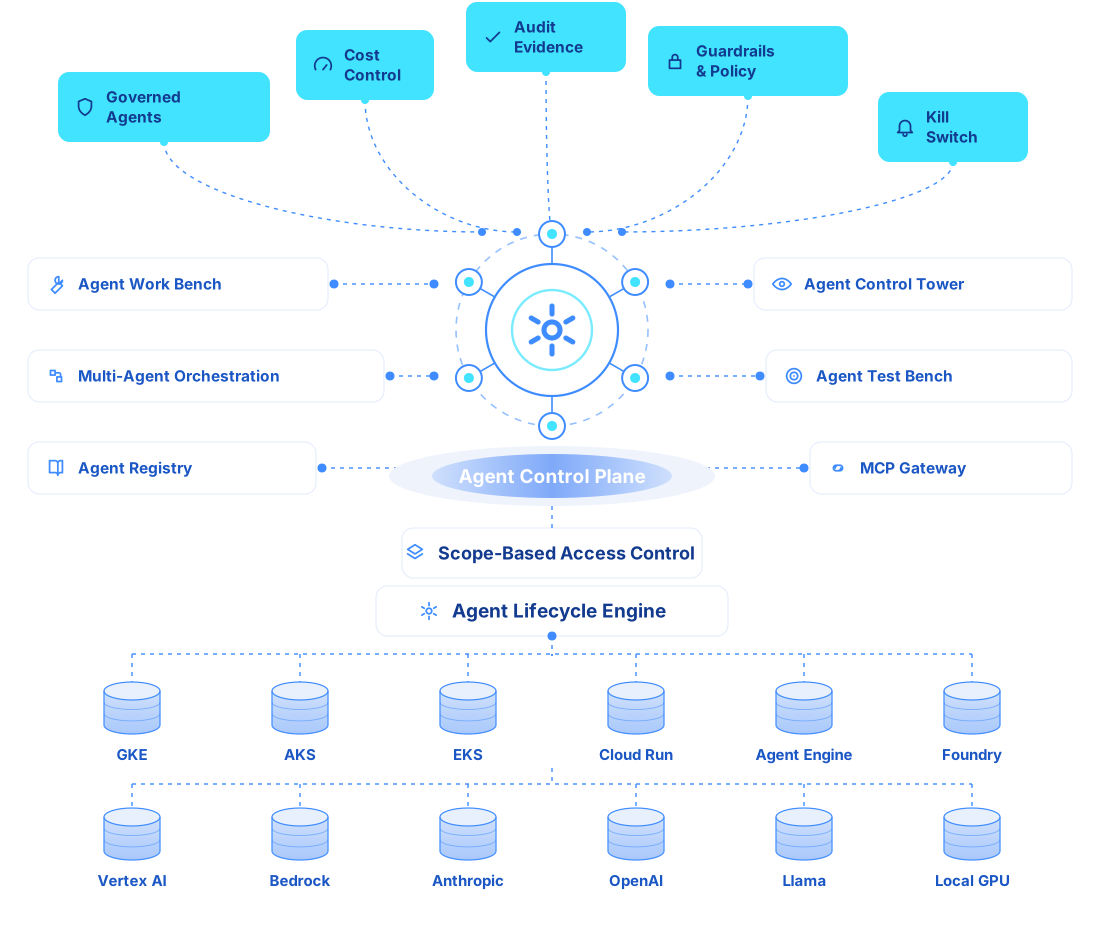
SERAA Cortex ships as five surfaces. Agent Work Bench, Agent Registry and Agent Control Tower are also available standalone, so an enterprise can adopt the part that matches its current maturity and expand later. The full feature-by-feature reference, every dashboard, panel and integration, lives in the docs; this is the shape of it.
The primary development environment. Technical and business teams create, configure and manage individual agents in one interface, with no-code and pro-code paradigms side by side rather than in separate tools.
A drag-and-drop canvas for wiring individual agents into coordinated multi-step pipelines, so a solutions architect designs and deploys a multi-agent workflow without custom engineering.
The authoritative record of what agents exist, where they are deployed and how they are managed across environments and tenants, including agents nobody on your platform team built.
The production operations centre for every live agent, activity, cost, performance, guardrail enforcement, LLM call logs and policy compliance in one place, regardless of where the agent was built.
The platform-administration surface behind the four lifecycle modules: who exists, what they can reach, which models and runtimes are available, and where the whole thing runs.
Agent Work Bench, Agent Registry, and Agent Control Tower, each ship as an independent offering. Build agents without taking the whole suite; govern agents built elsewhere without moving them; or monitor and control production agents regardless of where they were built and deployed.
Every external tool integration is a standardised MCP server, which is what makes agent-to-service communication secure, auditable and extensible rather than bespoke per tool.
Agents invoke and coordinate with other agents as sub-agents inside a workflow, including agents hosted on third-party platforms.
Agents are equipped with domain-specific retrieval-augmented generation stores so answers are grounded in your content rather than in model memory.
SERAA Cortex runs in any modern browser. Sign in with your organisation's Entra ID or GCP credentials and move across every module without re-authenticating.
Configure persona, model and system prompt, optionally attach a knowledge base, and exercise it in the integrated playground before it sees real data.
Create a deployment plan, choose the target environment (Dev, QA or Production) and deploy the instance. Or register an externally-built agent so it falls under the same governance.
The Registry's promotion workflow runs next, in order, before the agent advances.
Review dashboard metrics, watch live sessions, investigate LLM logs, set budget caps, tune guardrails. Full cost attribution and compliance reporting out of the box, with a kill switch on standby.
Most enterprises will run agents on more than one cloud, and most will inherit agents built in tools they did not choose. A governance layer that only governs its own agents governs nothing.
Orchestrate across OpenAI, Anthropic, Google, Azure and on-premise models simultaneously. No single point of failure.
Deploy on GKE, AKS or EKS, Cloud Run, Azure Functions, Foundry Agent Service or Gemini Agent Engine.
A Plugin SDK extends SERAA Cortex to proprietary runtimes, including on-prem and VPC edge.
Role-based access, tenant isolation and an immutable activity audit log, built in from day one rather than retrofitted after the first incident.
Guardrail policies enforce content safety, PII detection and redaction, and GDPR and HIPAA compliance across every deployed agent by default.
Forward-deployed engineers and strategists embed with your team, stand Covasant SERAA up inside your perimeter, and prove the first workflow. Then they hand it over.
We will show you what governing it actually looks like, catalogue, gates, cost attribution and kill switch, on your own cloud.