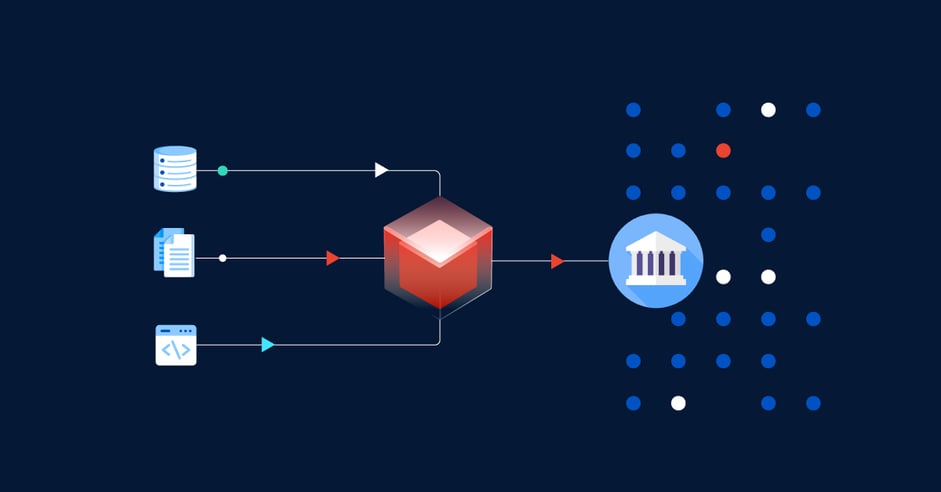
Banks are using AI agents to compress KYC checks and loan origination cycles from days to hours. The shift is not about removing humans from the process. It is about giving CFOs faster cycle times and giving CISOs a system they can audit, step by step, decision by decision.
The KYC and loan origination problem nobody puts in the pitch deck
If a regional bank's operations head had to describe her loan desk in one sentence, it would be; everything works until someone asks who approved what and why. That question used to take her team three days to answer.
- Documents lived in five systems.
- Analysts made judgment calls that never got written down properly.
- When an auditor arrived, the reconstruction work took longer than the original loan approval.
This is not a rare story. It plays out in almost every mid-size and large bank running KYC and loan origination on a mix of legacy systems and manual handoffs. The cost is not just speed. It is the risk that sits quietly in every undocumented decision.
Why manual KYC and origination slow everything down
KYC checks pull data from multiple sources. Identity documents, sanctions list, credit bureaus, beneficial ownership registries. Each source has its own format and its own delay. A human analyst stitches this together, checks it against policy, and escalates exceptions. Loan origination adds another layer. Income verification, collateral checks, credit scoring, underwriting rules that change by product and region.
None of this is technically hard. It is operationally heavy. Every handoff adds time. Every manual entry adds a chance of error. And every undocumented judgment call adds audit risk that surfaces months later, usually at the worst time.
How AI agents change the workflow
AI agents do not replace the underwriting policy. They execute it consistently, every single time, and they log every step while doing it. An agent can pull documents, run identity and sanctions checks, flag missing information, and route exceptions to the right human reviewer. What used to take an analyst four hours of cross referencing now takes minutes, with a complete trail attached.
The difference between this and older automation is important. Rule based automation follows a fixed script and breaks when reality does not match the script. Agentic systems reason through incomplete or unusual cases and still produce a decision trail that a human can review and an auditor can trust.
The audit question CISOs ask about AI agents
Speed without control is not a win for a bank. A CISO does not ask whether an agent can approve a loan faster. They ask whether every action the agent took can be reconstructed, explained, and defended. Who trained the model. What data it touched. Which policy version it applied. Whether the agent's reasoning is logged in a way that survives a regulatory review three years later.
This is where most agentic AI pilots quietly fail. They deliver speed in a demo and then stall in production because nobody can answer the audit question with confidence.
Five things every audit safe agentic workflow needs
1. Full decision traceability: Every agent action, input, and output logged in a format regulators can review.
This checklist holds regardless of bank size or region. Teams that skip even one of these five points end up rebuilding trust with regulators the hard way.
What agentic AI in banking means for the CFO
For a CFO, the KYC and origination cycle is a cost centre hiding in plain sight. Faster cycles mean lower cost per loan, higher throughput per analyst, and fewer abandoned applications from customers who got tired of waiting. A bank that cuts origination time from ten days to two days saves money and even wins deals that competitors would lose to slower paperwork.
What AI agent governance means for the CISO
For a CISO, the calculation is different. The goal is not to block AI adoption. It is to make sure every agent operating in the KYC and lending pipeline is governed the same way a human employee would be. Access controls, audit logs, clear accountability. Agentic AI done right actually strengthens audit posture, because it removes the inconsistency that comes with manual judgment calls.
Where Covasant fits into this shift
Covasant works with banks that need both outcomes at once, speed and control, without treating them as a trade-off. Our approach to agentic AI in banking focuses on governed orchestration. Every agent, regardless of what platform built it, operates inside a framework that logs, versions, and monitors its decisions continuously.
CFOs get the cycle time reduction they are measured on. CISOs get the audit trail they are accountable for.
This is the position Covasant holds in the market. Not another point solution promising faster KYC. A governance layer that makes agentic AI safe enough for regulated banking, and fast enough to matter to the business.
Frequently asked questions
What is agentic AI in banking?
Agentic AI in banking is the use of software agents that execute a bank's existing policy, such as KYC verification or underwriting rules, and log every step as they go. Unlike rule-based automation, agents reason through incomplete or unusual cases instead of breaking when reality does not match the script.
How do AI agents work in KYC and loan origination?
AI agents in KYC and loan origination pull documents, run identity and sanctions checks, flag missing information, and route exceptions to the right human reviewer. They do not replace the underwriting policy. They execute it consistently every time and attach a complete decision trail to the work.
Can AI agents fully replace manual KYC checks?
AI agents cannot fully replace manual KYC checks. Agents handle the repetitive verification work, while humans remain the checkpoint for exceptions and final judgment calls that carry regulatory weight.
How much time can AI agents actually save in loan origination?
Banks running agentic workflows commonly see origination cycles drop from several days to under 48 hours, depending on loan complexity and document readiness.
Does it matter which platform was used to build the AI agent?
It does not matter which platform was used to build the AI agent. A governance layer should be able to monitor and manage agents built on any platform, without forcing a bank to rebuild its existing stack.
How is AI agent governance different from model governance?
AI agent governance covers the running behavior of an agent, not only the model inside it. Model governance asks which model version was approved. Agent governance asks which policy the agent applied, where a human intervened, and whether the record survives a regulatory review years later.