Every enterprise can buy the same AI models. See why enterprise AI context lifts agent accuracy, lowers cost, and sets leaders apart in 2027.

The edge now lies in enterprise AI context: what your agents know about your business
Key takeaways
- A handful of providers take 69% of enterprise AI deployment dollars, so most companies now run on the same AI models.
- Business context doubled one leading model’s accuracy on business questions, from 46% to 93%.
- Putting clear business meaning into AI-ready data is predicted to lift agentic AI accuracy by up to 80% and reduce costs by up to 60% by 2027.
- Agents’ share of enterprise AI value is expected to increase from 22% today to 39% by 2030.
- Depending on its design, the same agent can use up to 30 times as many tokens, so context cuts cost as well as errors.
The Question Behind Every AI Strategy Is Changing
For the past few years, most enterprise AI strategies began with one question: which AI model should we use? Leadership teams compared vendors and performed evaluations to get the right answer.
That question is getting easier to answer now, because most enterprises land in the same place. Leading AI providers today take 69% of enterprise AI deployment dollars, up from 50% a year earlier. A competitor can sign up for the same model, through the same interface, on similar terms, next quarter.
The question that now separates enterprises is different: what do our agents know about our business? The answer is enterprise AI context: the business knowledge an agent needs to act the way your company would. It is quickly becoming the real edge enterprises have over their peers.
Why Do AI Agents Need Business Context?
Most leadership teams have already seen that agents write well and answer quickly. Yet agents miss the details that matter most: the approval limit, the contract clause, the exception the team signs off on every week. Teams end up re-explaining the same rules, and the answers stay generic.
None of this is a weakness in the AI model. It is the missing knowledge that was never given, which actually makes the business run.
How Much Can Business Context Improve an AI Agent’s Accuracy?
In one recent benchmark, adding business context doubled a leading model’s accuracy on questions with verifiable answers, from 46% to 93%.
The study, run by a semantic layer provider, shows how much that knowledge is worth. Seven leading AI models answered more than 400 real business questions twice. The first time, each model worked alone. The second time, each had a semantic layer, a shared map of the company’s business terms, and a view on how its data connects.
Every model improved. The model, the questions, and the data stayed the same. Only the context changed.
The study’s takeaway was that, “When every competitor can access the same intelligence, context becomes the advantage.”
Value Is Moving to the Layer Around the Model
The wider market points the same way. AI context platforms, which give agents a governed understanding of the business, now rank among the top strategic technology trends for 2027. Gartner states that organizations that put clear business meaning into their AI-ready data are predicted to lift agentic AI accuracy by up to 80% and reduce costs by up to 60% by 2027.
The layer around the model, which routes work, gathers the right context, and checks each output, is expected to drive three-quarters of AI platform decisions. Production results support both views. Across 107 agent deployments, multimillion-dollar returns have largely come from orchestrating workflows, combining data, and making decisions within the business, with domain-specific approaches described as the path to proprietary industry advantage.
The Stakes Rise as Agents Take On More of the Business
Agents already generate 22% of total AI value, up from 17% a year ago, and that share is expected to reach 39% by 2030. Companies with a full set of core AI controls in place generate three times as much agentic AI value as companies with just one, according to the Boston Consulting Group.
The shift reaches core operations too. IDC predicts that 60% of Global 2000 enterprises will run most of their business processes AI-first by 2029, up from 13% in 2026. As agents run more business operations, the value of every decision depends on how well they understand it.
Business Context in Practice: An Insurance Claim
Consider a property insurer handling a claim for water damage caused by a burst pipe.
An agent relying on general knowledge can read the claim, summarize it accurately, and route it to an adjuster for review. It completes the task well, but the decision still rests with the claims team.
An agent equipped with the insurer’s business context can take the claim further. It understands how the insurer defines “sudden and accidental” damage, the approval limit for that policy type and the repair partners that the claims team prefers. It assesses the claim against those criteria, approves it within the authority that the insurer has set, arranges the repair, and records its reasoning for the adjuster to review.
Both agents may run on the same model. What separates them is what each one knows about the business, and that contextual knowledge determines how quickly and accurately every claim is resolved.
What Is Enterprise AI Context, and What Is It Made Of?
Enterprise AI context is the business knowledge an AI agent needs to act the way a company would: its definitions, rules, approval limits, past decisions and the links between its systems. It sits around a shared AI model and has five elements.
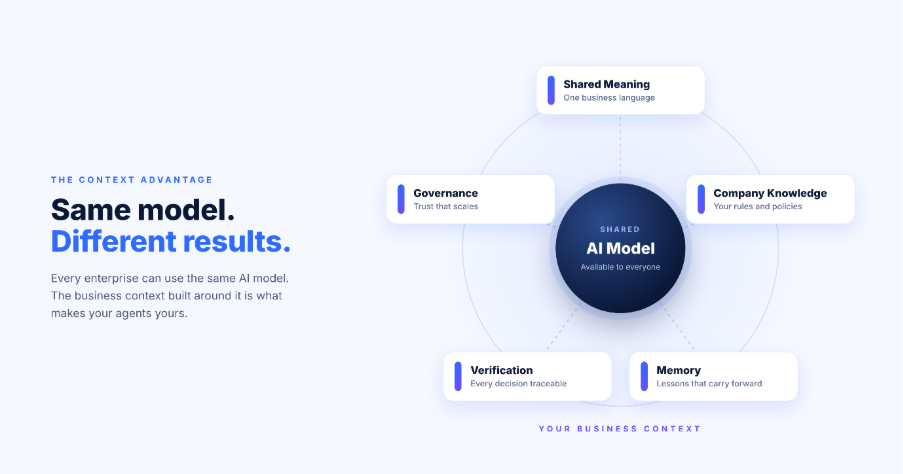
Five elements of enterprise AI context, built around a shared AI model.
- Shared meaning gives every agent the same definitions for a business’s key terms, so “active customer” or “approved supplier” means the same thing in every team and every workflow.
- Company knowledge gives agents the rules, policies, and approval limits that they need to make decisions the way the business does.
- Memory lets agents carry approved lessons from one task into the next, with a person deciding what becomes company knowledge.
- Verification records why an agent made each decision,so teams can check its work at any time. By 2028, 70% of Global 2000 enterprises are expected to continuously verify their agents’ decisions, up from 14% today, according to IDC.
- Governance sets the limits that each agent works within, which gives leaders the confidence to hand agents more responsibility over time.
Together, these five elements give agents the business knowledge they need to make accurate decisions, which leaders can trust.
“An agent can only make the call your best people would make if it knows what they know.”
How Does Business Context Lower the Cost of AI Agents?
Business context makes agents cheaper to run as well as more accurate.
AI usage is billed in tokens, the small units of text a model reads and writes. Every time an agent looks for missing information, re-reads a document or retries a task, it uses more of them. An agent that already has the business context it needs reaches the right answer in fewer steps, so the same work costs less.
The gap can be wide. Depending on how it is designed, the same agent can use up to 30 times as many tokens to complete the same job. Grounding agents in shared business context keeps them at the efficient end of that range.
For leaders, that means AI costs stay predictable as agents take on more of the work, which makes it easier to scale them with confidence.
Where Should an Enterprise Start With Enterprise AI Context?
Building enterprise AI context begins with a single, measurable decision. Leading organizations select a process where outcomes are already tracked, such as claims settlement time, invoice cycle time or client response time. They then define precisely what an agent must know to make that decision the way their most experienced people would.
The next step is to bring that knowledge into one governed foundation that every agent can draw on. SERAA Axon, built on the Covasant SERAA platform, provides the semantic layer for that foundation. It sits above the systems that an enterprise already runs and connects them into a single semantic layer, so agents work from the organization’s own definitions and data. Every answer includes its reasoning chain, which gives business and risk leaders clear visibility into how each conclusion was reached.
Once established, this context becomes a lasting asset. Each new agent builds on it from the start. Because it reflects how the organization actually operates, it is hard for a competitor to replicate.
Context is what turns shared AI into your advantage.
Talk to us to see how SERAA Axon can give your agents the context that sets your business apart.
Talk to UsFrequently asked questions
What is enterprise AI context?
Enterprise AI context is the business knowledge that agents draw on to make decisions, including the company’s definitions, rules, policies, approved lessons, and the links between its systems. It’s what allows two companies using the same AI model to get very different results.
How can AI agents create a competitive advantage if every company uses the same models
AI agents can create a competitive advantage through business context. When agents understand a company’s own data, rules, and decisions, they make calls that reflect how that business works. In recent research, the same model doubled its accuracy on business questions once it was given business context.
What is a semantic layer for AI agents
A semantic layer is a shared map of a company’s business terms and how its data connects. It means every agent reads “active customer” or “approved supplier” the same way, which improves accuracy and keeps answers consistent across workflows.
Does business context lower the cost of AI agents?
Yes. Agents with well-structured context reach answers in fewer steps and use fewer tokens. Gartner predicts that putting clear business meaning into AI-ready data will reduce agentic AI costs by up to 60% by 2027.
Where should an enterprise start with context-aware AI agents?
With one decision that the business already measures. Map what an agent needs to know to make that call well, build that context once, and reuse it for every agent that follows.
What are the five elements of enterprise AI context?
The five elements are shared meaning, company knowledge, memory, verification and governance. Shared meaning gives every agent the same business definitions Company knowledge supplies rules, policies and approval limits. Memory carries approved lessons forward. Verification records why each decision was made. Governance sets the limits each agent works within.
Is enterprise AI context the same as a semantic layer?
No. A semantic layer is a shared map of business terms and how data connects, which covers the shared meaning element. Enterprise AI context also includes company knowledge, memory, verification and governance, so agents can act the way the business would as well as read its data.