What is Compound Agentic Memory?
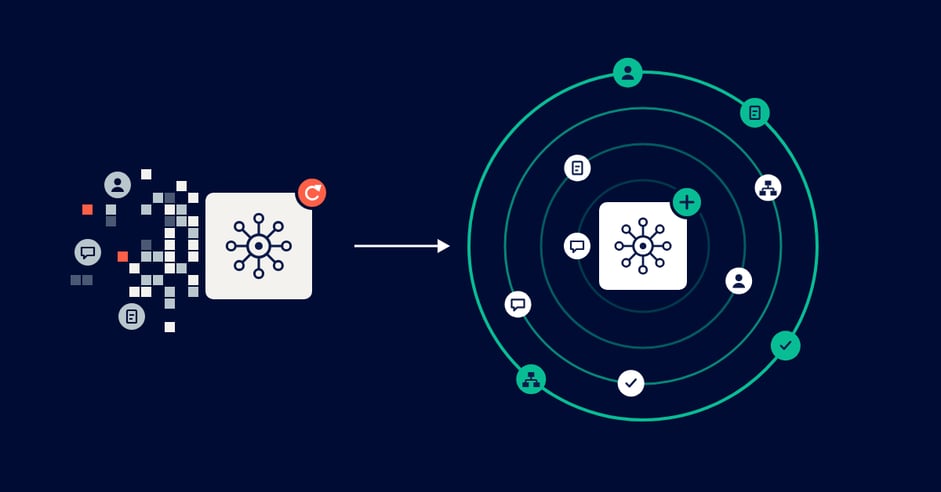
Compound agentic memory is a shared, governed memory layer for AI agents. It lets agents capture what they learn and reuse it in later tasks.
The word ‘compound’ matters. Each task adds to the knowledge, so the next task begins with a stronger base.
Take the case of a claims team at an insurer. The first week an agent handles a water damage claim and misses a regional exclusion in the policy. A reviewer catches the error and approves the correction. This is saved to the memory.
The following week, a different agent receives a similar claim. When the agent holds this context, it remembers the correction. It helps the agent to check the exclusion on its own and flags the issue in seconds. With time, the experience gets shared for better performance.
What does this mean for the business leaders?
An agent will repeat the same mistakes whenever it will start with zero memory. An agent with compound memory works like an experienced colleague. Through this governance helps to keep you in control of the actions taken.
What is the Stateless Enterprise AI Problem?
A stateless agent keeps no lasting record of the past work. It sees only the information in front of it during one session. When the session ends even the context is gone.
Explaining this better, here’s an example of an analyst who loses all the memory every night. That analyst is smart but needs to relearn the job each morning. If most enterprise agents behave this way it will affect the workflows and financially impact the enterprise.
For the pilots this works, but when issues get exposed when it goes into production. Loss of context adds to the expense when hundreds of agents run across finance and customer service.
Why Statelessness hurts the Business?
Analysts see the same symptoms in many enterprises:
- Repeated questions: Users restate context at every interaction.
- Inconsistent decisions: Two different ways get implemented to handle the two agents for the same case.
- Higher cost: Tokens get burnt and review time increasing while rebuilding the context.
- Lost knowledge: Approvals and exceptions stay trapped in old sessions.
- Weak audit trails: When the agent acted nobody can show what the agent knew.
Whether it is the first time or the last time, when a process runs 10,000 times it doesn’t tend to get smarter. This is the hidden ceiling on ROI for AI.
Why does Retrieval alone not fix it?
Many teams add retrieval and assume the problem is solved. Retrieval helps an agent find documents. It does not record what the agent decided or why. It also does not record whether the outcome was good.
Retrieval reads the company’s files. Memory records the agent’s own experience. Enterprises need both layers working together.
How Does Compound Agentic Memory Work?
-
- Working memory holds the context of the current task. It includes the goal and the steps taken. It stays temporary as the system clears this memory when the task ends.
- Episodic memory records past cases and their outcomes. This helps to avoid mistakes as the system recalls what has happened earlier.
- Semantic memory stores business facts and how they connect, such as products and policies. With reliable understanding of the domain, this knowledge enables the system.
- Procedural memory keeps the methods that work best, such as playbooks for refunds or escalations. The system learns which practices deliver success by remembering the best practices.
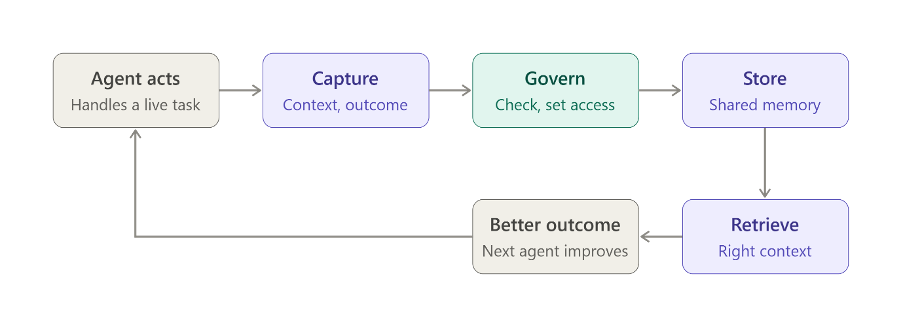
The record stays clean and safe to reuse with the help of the governance.
Why Governance decides the outcome?
Memory without control creates a new risk. A wrong memory tends to spread across many agents faster than any human error. In this case, leaders should ask five questions:
- Who can see each memory?
- Where did the memory originate from?
- Is the memory still accurate for application?
- Can it be corrected or deleted?
- Does it work across vendors and clouds?
Shared memory does not create shared truth on its own. When a memory is not effectively governed it can create conflicting versions of the same fact. Good platforms use the approval process rules for new entries. They also use confidence scores, expiry dates and monitor the complete audit trails.
What are the Business Outcomes you can expect?
- Speed and consistency in service
Agents that remember past cases stop asking users to repeat themselves. Every agent draws on the same approved history. Answers become consistent.
- Lower operating cost
Reusing verified knowledge cuts repeated reasoning. Fewer cases need human escalation. Teams spend their time on true exceptions.
- Stronger compliance and audit readiness
When the memory is governed it shows the entire story, like, what an agent knew and where that knowledge came from. This turns a black box into an auditable process. Regulated sectors such as banking and healthcare benefit the most from this.
- Onboarding of new agents gets faster
A new agent connected to shared memory inherits the organization’s experience on day one. It does not need to be retrained on every policy.
- Steady improvement and no need to rework constantly
Teams no longer rewrite instructions every quarter. Memory can capture what works and poor outcomes get flagged off for review.
Here’s a Five-Step Roadmap for Business Leaders
This certainly does not mean that you need to rebuild your entire AI estate. You can take a phased- out approach.
Step 1: Find where memory loss or loss of context affects the most. You need to look for workflows with repeated questions or uneven decisions. Over here processes like claims handling and onboarding are common starting points.
Step 2: Decide what you must remember at an early stage. While some steps can expire, some facts hold a lasting value for the workflow.
Step 3: Set the governance rules first. Here you can agree on access, retention and approval before you can scale the processes.
Step 4: Choose a platform-agnostic memory layer. Most enterprises run agents from several vendors. Hence, the silo problem or working in isolation issues comes up.
Step 5: Measure the compounding effect. Track first-contact resolution and escalation rates, cost per task and audit readiness as well. It is evident that the memory is working when the gains are steady.
What to look for in an Enterprise Memory Platform?
Use this checklist during vendor evaluation:
- Supports working, episodic, semantic and procedural memory
- Works across agents, models and clouds
- Enforces role-based access and privacy rules
- Records the source and owner of every memory
- Allows correction, expiry and deletion
- Connects to existing ERP and CRM systems
- Shows how memory influenced each decision
Give your agents a memory that works
Memory is what separates a clever demo from an agent estate you can trust. Without it, every agent starts cold, repeats old mistakes, and guesses at context your business already holds.
Covasant SERAA closes that gap. This Enterprise Intelligence Platform sits between the systems you already run and the agents that you need to deliver. SERAA Synapse gives agents hierarchical memory that mirrors your organization, and nothing becomes company knowledge until a person approves it. SERAA Cortex runs every agent under one policy, one catalogue, and one audit trail. SERAA Axon grounds their answers in your own data.
Start with the problem that hurts the most.
Bring us one question your data can’t answer, or one agent estate nobody can see,
and we’ll show you which layer you need first.
Book your demo with Covasant SERAA