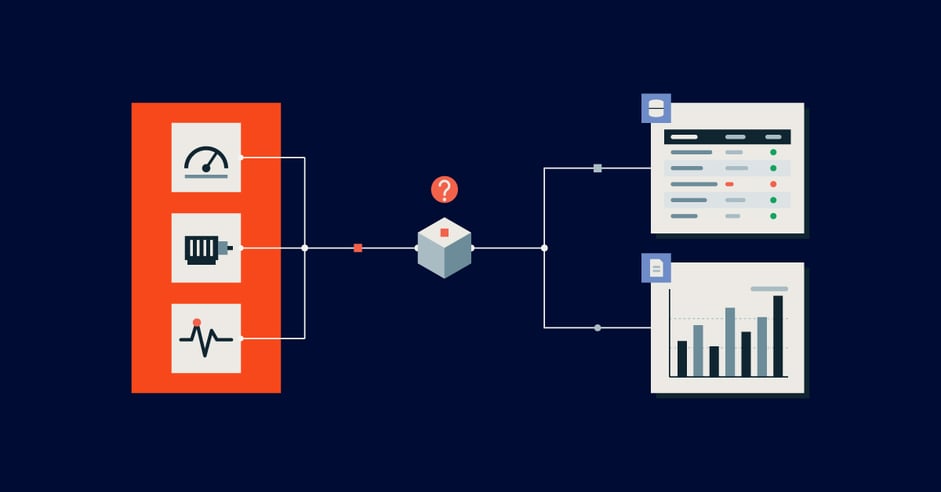
In an industrial set-up, enormous amounts of data flows from every plant. Vibration readings and temperature trends stream in all around the clock. Pressure curves and machine logs keep flowing through. But critical decisions still come too late in many operations teams, that too sometimes only after things have gone down south. After the alarm blows, the production stops and everyone rushes to figure out what happened.
There is nothing like ‘lack of data’. In fact, the issue is the gap in how data turns into decisions. There is operational technology (OT), which covers the control systems and there are sensors that keep the plant running. While the information technology (IT) is home to the cloud platforms and the analytics teams.
Part of the answer is with each side.
Different priorities and different systems keep them apart, and a different technical language adds to the distance. Between the two sides, insights get stuck. The moment to act has passed by the time they reach the people on the floor.
Changing that is the promise of Industrial AI. Connecting plant-floor signals with predictive models shifts operations from reacting to failures toward anticipating them. A bearing that starts to degrade gets flagged early. A process that drifts out of spec gets caught before it becomes downtime. Technology alone does not close the gap. Shared ownership and trusted data are what close it. Recommendations that operators can understand and act on matter as well.
How Industrial AI enables predictive plant operations is the preliminary question. Why the IT/OT divide holds so many initiatives back comes next. What it takes to turn predictions into confident, timely decisions follows, eventually.
How does Industrial AI enable predictive plant operations?
Artificial intelligence applied to physical operations is Industrial AI. It can monitor equipment and recommend actions. Forecasting equipment problems before they stop production is the purpose of predictive plant operations. Keeping those forecasts from turning into action is what the IT/OT decision gap does.
Enterprise data and cyber security fall under IT, or information technology. Machines and control systems fall under OT, or operational technology. A good prediction can sit unused when the two teams work from separate data and separate goals. Insight that never changes an outcome is what the business then pays for.
Why does this matter to business leaders?
The stakes show most clearly in downtime. A yearly loss of $1.4 trillion from unplanned downtime is what Siemens research reports for the world’s 500 largest companies, which equals about 11% of their revenue. A single lost hour can cost $2.3 million in the automotive sector.
This loss remains open despite AI investment. Industry figures show that three in four manufacturers have built AI into their strategy. However, only one in five AI initiatives can reach its business goals. The link between enterprise systems and the plant floor is often the weak point.
Why does the IT/OT Decision gap exist?
The different missions of each team are the starting point. Reliability and safety are the focus of OT teams. Speed and data access are the focus of AI teams. Valid goals on both sides collide when no one sets shared rules.
Five patterns reveal the collision:
- Data silos. Control systems hold the machine readings. Enterprise systems hold the maintenance and supply chain records. Across both, no model can reason.
- Missing context. Little meaning attaches to a vibration alert without the repair history of that machine. Little meaning remains if nobody knows whether a spare part is in stock.
- Split ownership. Nobody is sure who approves the repair when an alert fires. Delay erases the value of the early warning.
- Security concerns. Hesitation is the right response from OT leaders when live equipment connects to wider networks. Integration will be blocked without a safe design.
- Low trust. Advice that operators cannot explain gets ignored. Rarely do black box recommendations survive on the plant floor.
What can this gap cost an industrial plant?
Picture a warning that arrives three days before a bearing fails. The production schedule and the spare part stock are what the maintenance planner needs. Safety rules are also on the planner’s list. Before anyone acts, the warning expires if that information sits in three separate systems. The same unplanned stop that predictive operations should have prevented is the result.
At exactly this point, many pilots stall. That a model can predict is what they prove. That the organization can act on the prediction is what they never prove.
How do Predictive Operations work in practice?
Let’s compare these two maintenance models. A calendar drives preventive maintenance. The real condition of the machine drives predictive maintenance. Live machine data is what predictive tools watch. Signs of failure get flagged, and teams can schedule the repair for a planned stop. Equipment life extends as a result.
This works because data is joined. Machine data linked to production schedules and maintenance history is what predictive models need, according to industry analysis. Parts availability must also be linked. The IT/OT seam in action is that link.
Follow one signal from the machine to the decision. A clear owner stands behind each step.
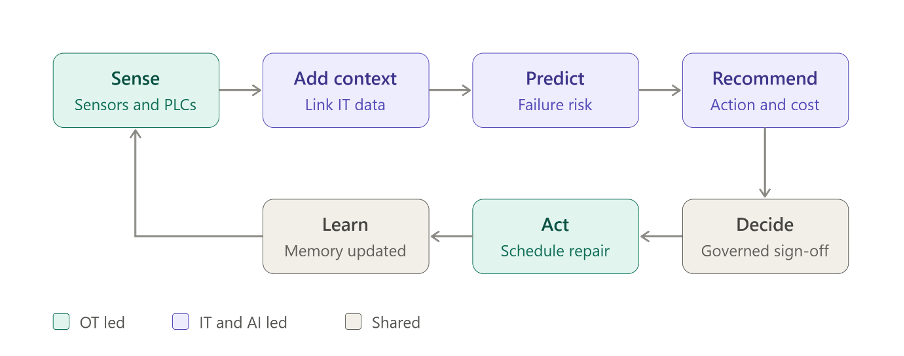
Five Solutions that can close the gap
1. Build a shared data foundation
Your plant machines, your business systems, your maintenance records, and your overall data from the plant all hold useful data today. But they rarely talk to each other. So, it’s important to bring them together. While you do that choose open, widely used standards, so that adding a new machine does not require a special setup. Also, fund this as a shared resource, not a one-off project cost. In this way, every AI project in the future can use the same data instead of starting it from scratch.
Leaders can name who owns the budget before the first pilot begins.
2. Add business context to every signal
An alert on its own says little. ‘Pump 4 is running hot’ does not tell anyone what to do next. Attach the machine’s repair history to every alert. Then show how that machine affects the production plan. With this picture, the system can suggest the best time to fix the problem, such as a slow shift, so output stays protected.
Leaders can agree on what business information every alert must include.
3. Assign joint ownership
In many plants the operations team and the IT team work separately. When there is an issue, no one owns the result. So, form a team that includes both the groups, plus the AI specialists. Give them shared goals and ownership of data.
Leaders can even appoint one executive sponsor who can answer for the results shared by both the operations and IT sides.
4. Set clear decision rights
You can decide on the approval protocols in advance, where the system can handle low-risk tasks on its own, while a person needs to be approached to approve anything that puts safety or production at stake. Make sure every recommendation explains its reasoning too.
Leaders can register these rules and review them every quarter.
5. Secure the connection and keep an audit trail
Keep the business network and the plant control network separate and monitor them through connected points. Keep a record of every recommendation made by the system and what people have done in response. This record leaves an audit trail and gives confidence for the plant leaders too.
Leaders can make the audit trail a requirement before launch.
Track four measures that IT and OT leaders both respect:
- Unplanned downtime hours
- Alert-to-action time
- Mean time to repair
- False alert rate
When the alert-to-action time reduces, it is a clear sign that the gap is closing.
Turn Plant Data into Governed Decisions with Covasant SERRA
Confident action on connected IT and OT intelligence is what Covasant SERRA helps industrial enterprises achieve. Shared memory and coordinated AI agents support governed decisions across your plants. Faster answers and a full audit trail go to your teams.
Give your agents a memory that works
Memory is what separates a clever demo from an agent estate you can trust. Without it, every agent starts cold, repeats old mistakes, and guesses at context your business already holds.
Covasant SERAA closes that gap. This Enterprise Intelligence Platform sits between the systems you already run and the agents that you need to deliver. SERAA Synapse gives agents hierarchical memory that mirrors your organization, and nothing becomes company knowledge until a person approves it. SERAA Cortex runs every agent under one policy, one catalogue, and one audit trail. SERAA Axon grounds their answers in your own data.
Close your decision gap now.
Book a demo with Covasant today and see how SERRA and its product line can power predictive plant operations at scale.
Book your demo with Covasant SERAA