Most factories run into trouble for a simple reason. Small delays pile up, and nobody catches them in time. Here is what that looks like in practice. Let’s say, an order is waiting for approval. It sits in the ERP (Enterprise Resource Planning) system. Nobody approves it in time.
Meanwhile, a machine on the shop floor is heating up over its defined limits. The SCADA (Supervisory Control and Data Acquisition) system that tracks equipment like this in real time assesses that the temperature rise is small. Hence, there is no alarm raised.
At the same time, a batch of product is edging towards quality issues. The MES (Manufacturing Execution System), which oversees day to day production, records the reading. Considering that it is assessing it on its own, it does not flag it as a problem.
None of these are big problems on their own. But nobody catches them in the moment. Left alone, small issues like these quietly add up, cutting into profit and product quality every quarter.
This is the exact problem AI agents are built to solve. Not chatbots to answer queries or dashboards that show numbers after the fact. Agents perceive a signal. They reason through options. They act within defined limits, before a human even opens a screen.
https://www.covasant.com/industries/manufacturingManufacturing leaders in 2026 very well know that https://www.covasant.com/industries/manufacturing. At this moment, they are asking which system to connect first, ERP, MES, or SCADA and which workflow to hand over.
A factory rarely fails from one big shock. It fails from small delays nobody notices in time.
Why the old Playbook stopped working?
For decades, manufacturers managed disruption through buffers. More safety stock. Longer lead times. Quarterly supplier audits. This worked when volatility was occasional. It also worked when ERP, MES, and SCADA data existed in silos, and no one had to reconcile them in real time.
But it’s not applicable in the present times, as trade policy shifts overnight. A single port closure can stall a line on the other side of the world.
When the ERP holds the purchase order, the MES holds the production schedule, and the SCADA layer holds the sensor reading. This explains why the schedule slipped, but these systems do not exchange data quickly to prevent the disruption. Weekly, batch-based planning simply cannot keep pace with operational issues that unfold in hours.
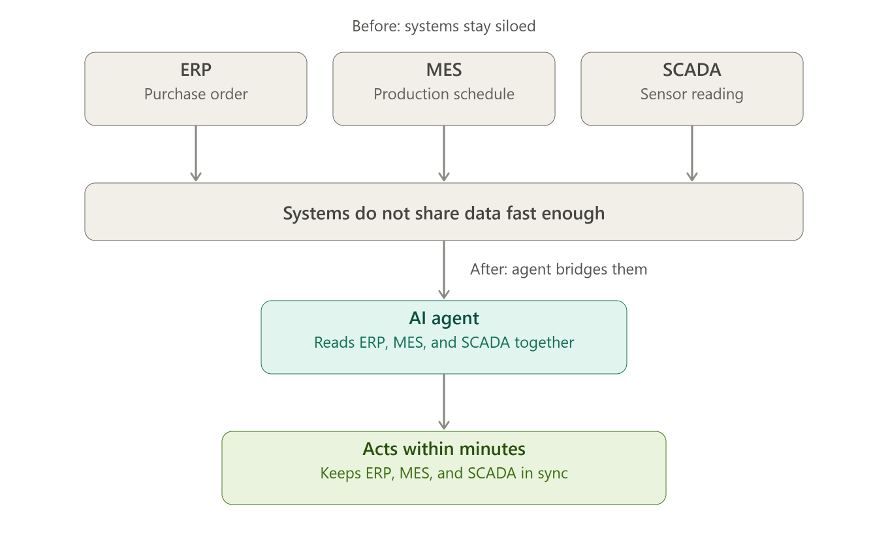
Leaders now know resilience depends on speed. Speed of detection and response. And that speed depends on connecting the three systems that run a factory. That is precisely where AI agents change the equation.
An AI agent, in plain terms, is a software system that watches live operational data. It decides what needs to happen. It carries out that decision inside limits a human has already approved. It differs from a chatbot because it acts. It differs from a dashboard because it does not wait for someone to read it. Placed correctly, it sits above ERP, MES, and SCADA at once. It acts where a human would otherwise stitch the picture together by hand.
From Prediction to Action
While traditional analytics tools only predict delays and leave planners to manually check systems and reorder, AI agents eliminate this gap by taking immediate action.
A mid-size auto components manufacturer runs three plants. A key fastener supplier signals a three-day delay through the ERP. In a traditional setup, the alert sits in an inbox overnight. A planner reviews it the next morning. By then, production has already stalled.
With an agent connected to the ERP, the sequence changes.
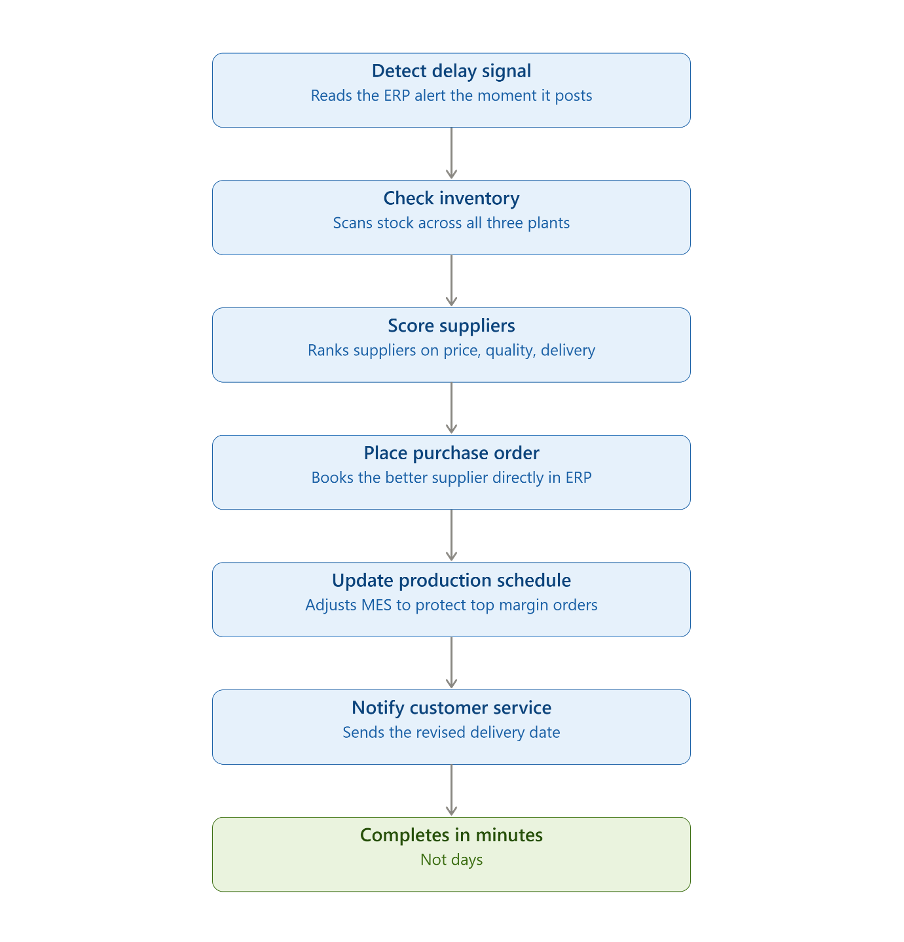
This is the gap between reacting to disruption and absorbing it. A minor supply shock no longer escalates into a missed shipment. It gets corrected before a customer ever notices.
How AI turns Quality Inspection into automatic correction process?
While supply disruption gets most of the attention, quality variance is the quieter cost centre. A few degrees of temperature drift on the SCADA layer, a slightly worn tool logged in the MES, or a batch reaching its limits, rarely triggers an immediate stop. Yet these subtle issues escalate into costly rework and scrap.
A packaging manufacturer shows how powerful this connection can be. Its SCADA system spotted visible defects, but its MES logged rework orders separately. Thus, keeping scrap rates high because the systems never communicated.
This changed when the company linked its SCADA sensors to an AI agent that uses the MES as its source of date. So, instead of just flagging defects, the agent finds the root cause of parameter drift, adjusts settings within safe limits, and logs the fix in the MES. As a result, defects dropped quickly, production improved, and operators stopped wasting time fixing problems that the agent had already solved.
This proves that AI agents reading SCADA and MES data continuously catch minor issues before they turn into customer-facing defects. Quality moves from a final inspection step to an automatic, ongoing correction.
How do AI Agents protect human judgment rather than replace it?
A common concern among plant leaders is control. Nobody wants a system making unsupervised calls on safety or compliance. The best deployments respect that concern.
Mature AI agent programs operate inside clear boundaries across all three systems. Like, an agent can reroute a shipment in the ERP within an approved supplier list. It cannot approve a new vendor without human sign off.
It can adjust a machine parameter on the SCADA layer within a validated range. It cannot change a specification stored in the MES. Every autonomous action gets logged for audit, especially for regulated industries governed by standards like ISO 9001.
This allows the engineers to spend their time on judgment calls rather than assessing or reconciling data manually. Agents preserve institutional knowledge by encoding it into workflows. So, a plant does not lose years of expertise the day a veteran planner retires.
What leaders do differently:
- Start narrow. Pick one workflow, such as supplier risk scoring in the ERP or defect detection on the SCADA layer.
- Prove value before expanding.
- Build real time pipelines across ERP, MES, and SCADA, instead of relying on batch reports that are pulled from one system at a time.
- Pair every agent with a clear escalation path, so that humans continue to stay accountable for high-stakes decisions.
Where the mindset shift happens:
Manufacturers stuck in pilot mode treat agents as a technology layer bolted onto one system. While the ones pulling ahead see agents as the connective layer that finally lets ERP, MES, and SCADA operate as one coherent view of the plant.
What culture requires:
- Operators need to trust that an agent will flag its own uncertainty rather than guess.
- Quality engineers need visibility into every automated correction inside the MES.
- Programs that build this trust early scale faster than programs that focus only on the technology.
Manufacturing clients do not come to Covasant looking for another dashboard
They come looking for agents that sit across ERP, MES, and SCADA. Agents that resolve exceptions, not just report them.
Covasant's approach follows the same discipline the strongest programs share. We pick a workflow with clear cost impact, then connect ERP, MES, and SCADA data in real time, instead of weekly reports. We define what the agent can decide on its own and confirm where a human stays in the loop, then prove the result before scaling to the next line or plant.
Manufacturing clients working with Covasant are seeing what this discipline produces. Know more what Covasant can do in Manufacturing.
The manufacturers who win the next decade will be the ones whose agents already run quietly across ERP, MES, and SCADA.
Connect now for a quick demo