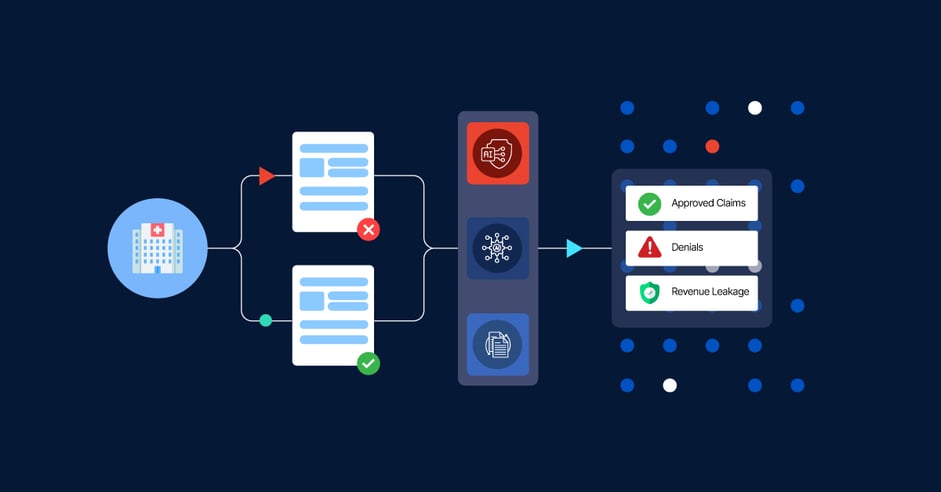
Agentic AI in healthcare revenue cycle management leverages autonomous agents to review claims before submission, checking documentation against payer requirements and flagging errors early. This shifts denial management from reaction to prevention, reducing revenue leakage caused by missing modifiers, expired authorizations, and coding mismatches.
A billing manager at a mid-sized hospital will mostly describe his/her week in one sentence. Monday brings new claims. Friday brings denials from claims submitted a month earlier. In the process, their team spends more hours chasing old rejections than processing new work. This pattern plays out in finance departments across every week.
It is not a gap in staffing. It is a design flaw in how the revenue cycle operates.
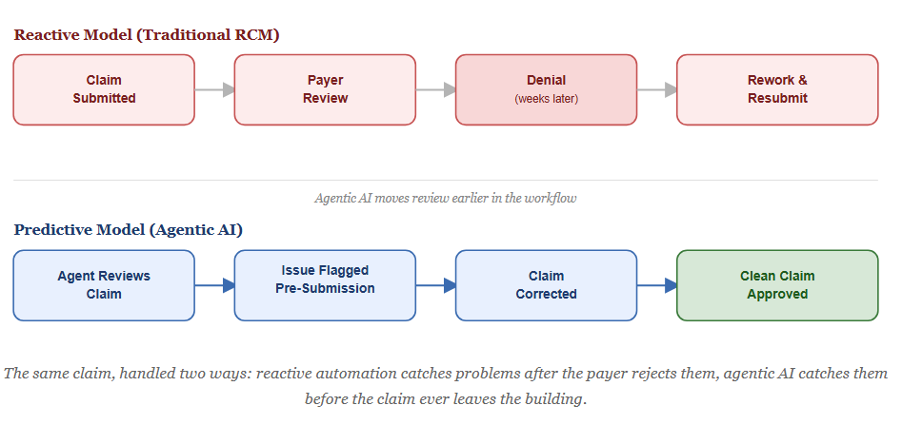
Healthcare revenue cycle management has run on the same logic for two decades. Submit a claim. Wait for a response. React when the payer says no.
This model worked when claim volumes were lower. It worked when payer rules changed less often. Neither of these conditions hold valid today. Payer policies shift constantly. Prior authorization requirements grow stricter every year. A system built to react cannot keep pace with rules that keep moving.
Agentic AI changes that underlying logic. Autonomous agents review claims before they leave the building.
- Check documentation against payer requirements.
- Flag missing or inconsistent information before submission.
- Act more like a coworker embedded in the workflow than a tool bolted on top of it.
- Work shifts from correction to prevention.
What Is the real Cost of Claims Denials in Healthcare?
Denial reduction has become a board-level priority for healthcare finance leaders. Hospital margins remain thin. Every denied claim adds friction to an already strained system. Someone has to review the rejection and resubmit it, track the appeal through to resolution.
Each step pulls staff away from higher-value work.
Most denials trace back to preventable errors. Like, a missing modifier, an expired authorization, a mismatch between the clinical note and the billed code. These reflect a process built on manual review across thousands of claims a day. Small errors become statistically inevitable at that scale.
Revenue leakage compounds the problem quietly, building gradually rather than all at once: an underpaid claim here, a missed filing window there, an undercoded encounter that never gets caught. None of this makes headlines on its own, but together it erodes margins that hospitals cannot afford to lose.
Why Traditional RCM Automation cannot stop Denials
Rules-based automation helped hospitals handle volume. It could scrub claims against a fixed checklist and catch the obvious formatting errors. However, this worked for routine, predictable claims. It struggled with anything that required judgment.
A denial with an unusual root cause still needed a human to investigate.
Agentic AI works in a different way, it reasons rather than follow instructions. These systems read clinical documentation, cross-reference payer-specific policies. They learn from patterns in historical claims data. When a claim looks like it might get denied, the agent identifies the root cause and recommends a fix even before the claim reaches the payer.
This can be compared to the difference between a smoke detector and a fire suppression system. A smoke detector alerts you after smoke has already filled the room. But a suppression system detects the early conditions of a fire and intervenes before the fire spreads.
Agentic AI behaves like the second system. It steps in prior to a crisis or issue crops up, when the cost to fix the issue is still manageable.
How does Agentic AI shift Revenue Cycle Management from Reactive to Predictive?
Consider a mid-cycle coding team reviewing a complex surgical claim. In the old model, the claim goes out and gets denied for insufficient documentation. It lands back in the queue three weeks later.
Now, the coder has to reconstruct context from memory and scattered notes.
In a predictive model, an AI agent reviews the encounter before submission. It notices the operative note is missing a required detail. It flags the gap immediately, while the surgical team still remembers the case. The claim goes out complete. Ultimately, the denial never happens.
This shift changes where effort gets spent across the revenue cycle. The staff time moves away from repetitive correction work, toward complex cases that genuinely require judgment.
Top Use Cases for Agentic AI in Healthcare Revenue Cycle Management
Eligibility verification is a natural starting point. Front-end errors in eligibility checks drive a large share of first-pass denials. Agents can verify coverage and benefits automatically even before a patient reaches the billing desk.
Prior authorization sits under growing regulatory pressure. Newer requirements push payers toward faster turnaround and clearer reporting. Agentic systems can track authorization status across multiple payers. They can initiate requests without manual follow-up.
Coding accuracy improves when agents read clinical documentation the way a trained coder would. They compare the note against the assigned code and catch mismatches before submission.
Denial prediction closes the loop. Agents analyse historical claims data and score each claim's likelihood of denial before it leaves the organization. High-risk claims get routed for review, while low-risk claims move through without any delay.
Why Governance and Compliance matter in Agentic AI for RCM
None of this works without strong oversight. Healthcare finance operates under close regulatory scrutiny. Hence, AI systems handling claims data need to meet the same standard of accountability that once applied only to human staff.
Every recommendation an agent makes should be explainable. Every automated action should leave an audit trail.
Human oversight remains central to this model. Agentic AI works best as a partner to revenue cycle staff. The agent handles volume and pattern recognition at a scale humans cannot match. The human handles nuance and final accountability.
How to build a Revenue Cycle that prevents Denials in the first place?
Healthcare organizations that treat AI as a bolt-on tool will mostly see limited results. The organizations seeing real gains are redesigning their revenue cycle around the concept of prevention. They will ask how to stop it from happening in the first place.
This requires a change in mindset at the leadership level. Revenue cycle strategy can no longer sit inside the finance department alone. It has to connect clinical, financial, and technology teams into one coordinated system. Agentic AI provides the connective layer that makes this coordination possible at scale.
How Covasant is solving Claim Denials before they happen in Healthcare Revenue Cycle Management
Covasant has spent years working alongside healthcare organizations to solve exactly this kind of structural problem.
At the centre is SERAA, an enterprise-grade platform for building, orchestrating, and governing AI agents across the full agent lifecycle. In healthcare, SERAA powers agents that verify eligibility, validate clinical documentation, and predict denial risk before a claim reaches a payer, with every decision explainable and auditable rather than delivered as a black box.
Covasant builds on a cloud-flexible, HIPAA-aware architecture that fits into the existing hospital IT environments, and its governance framework carries ISO/IEC 42001:2023 certification, a standard built for exactly the kind of regulated, high-stakes decisions healthcare demands.
Healthcare organizations do not need another dashboard that reports on denials after they happen. They need a partner that helps prevent them from happening at all. Covasant brings deep domain expertise in healthcare revenue cycle management together with proven agentic AI engineering, giving providers a revenue cycle that anticipates problems instead of chasing them.
The future of revenue cycle management belongs to organizations that stop treating denials as a cost of doing business. Covasant is helping healthcare leaders build that future, with the domain grounding and platform maturity to make autonomous decision-making trustworthy at scale.
Stop Chasing Denials. Start Preventing Them.
See how SERAA's agentic AI verifies eligibility, validates documentation, and predicts denial risk before a claim ever reaches a payer, with every decision explainable and audit-ready.
Schedule a Demo