The US AI Landscape
Forrester’s 2026 report on US AI regulations states, "US legislation to ensure safe, responsible, and transparent AI is now a patchwork of state and local laws, but that doesn’t mean that organizations are off the hook." This has created a tricky environment for enterprises.
To stay safe and compliant, companies are recommended to follow these steps:
-
Adhere to strict standards: Comply with industry regulations always, including local laws and regulations.
-
Audit the entire system: Audit how the AI system accesses data and factors in human intervention when things go wrong.
-
Fix vendor contracts: Most AI vendors offer limited protection. Update your contracts to clearly state who is responsible when a third-party AI model causes a legal problem.
- Enable continuous monitoring: While existing GRC tools are a starting point, purpose-built platforms are necessary to monitor real-time model performance and data reliability.
The High Cost of Disorganized Orchestration
Disorganized orchestration creates significant liabilities for the modern enterprise. Fragmented management leads to serious legal and regulatory exposure as government bodies increase scrutiny on deceptive practices. Organizations find themselves unable to provide audit ready evidence that their agents follow internal policies or safety guardrails. This lack of oversight makes defending against litigation or consumer protection violations extremely difficult.
Gartner’s research highlights a direct link between organizational structure and profitability. A key insight from Gartner’s report, Governance Framework for GenAI and AI Agents in Applications, concerns the impact of a centralized strategy. It advises application leaders to establish a comprehensive GenAI governance framework that bridges the gap between high-level strategy and specific application projects.
As per the insights, organizations with a centralized generative AI strategy demonstrate significantly higher confidence in governing systems, implementing effective change management, upskilling the workforce, and accurately assessing business value.
Organizations that lack formal agent-orchestration platforms will see lower returns from AI platforms in the future. This is a massive return gap that compounds every quarter.
The problem centers on operating models. Vendors build sophisticated orchestration layers, but enterprises often lack the internal structure to use them. Without clear ownership, orchestration splits across IT, product, and operations.
ROI curves flatten because coordination overhead grows faster than the benefits. Setting up a dedicated office to own autonomy policies is highly recommended. This function serves as the single counterpart to AI vendors and maintains a unified view of risk across the company.
Six Principles That You Should Follow in Production
Governance sounds abstract until you have to explain a failed agent decision to a board. These six principles work consistently in enterprise deployments.
- Maintain an Agent Registry: Visibility is a prerequisite for governance. Establish a unified list of every deployed agent, its owner, its authorized actions, and its data permissions.
- Design Authority First: Define the rules of engagement before the first agent goes live. Determine who sets business intent and who intervenes when a system drifts.
- Embed Human Oversight: Map every workflow to identify which decisions are autonomous and which require human approval. Escalation paths must exist within the architecture.
- Use Orchestration Layers: Point-to-point integrations create contradictions. A central orchestration layer provides a single control plane to coordinate activity and preserve context.
- Opt for Complete Traceability: Ensure every decision is explainable on demand. Timestamped records of every agent action are necessary to transform a liability into a functional framework.
- Track Governance Metrics: Treat governance as a business metric. Monitor the cost per decision and the cost of errors to help the organization scale faster.
The Strategy Gap
There is a massive gap between corporate strategy and daily operations. While many organizations claim to have a centralized AI strategy, only a few tend to apply it consistently. This lack of discipline leads to increased costs and compromised security. Applications become obsolete faster when they do not align with a broader framework.
The organizations winning the race in 2026 have better conditions in addition to better AI models. HFS Horizons: Agentic Technology 2026 report assesses that ‘the bottleneck is no longer the technology but enterprise operating models, data readiness, and governance maturity.’
Mapping controls across international standards like the NIST AI Risk Management Framework is advisable.
This ensures readiness across all jurisdictions. AI vendor indemnifications rarely cover how a customer uses a model. The accountability always stays with the enterprise.
Achieving Operational Confidence
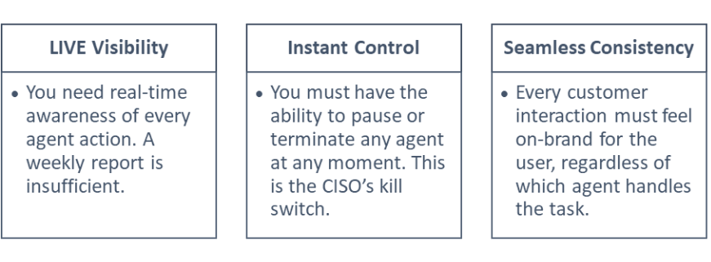
If your goal is operational confidence, then it requires three elements to be true at the same time.
Four Questions for Your Team
Ask your team to find answers to four important questions this week.
- How many agents are deployed and where are they?
- What happens if an agent makes a wrong decision right now?
- Can we produce a full audit trail for the last month?
- Is the customer experience consistent across all automated channels?
If your team cannot answer these questions promptly, then your governance gaps are real.
Fixing these gaps requires an honest audit and a structured plan to close gaps based on risk. If you do not choose a formal path for ownership, then you are choosing bad outcomes by default.
The agents are already on the move. Are you governing them, or are they governing you? Build the infrastructure now. The runway for preparation is shorter than what most boards realize.
Are you looking at answering the ‘How to’ in your Agentic AI adoption journey? You can meet Srikanth Chakkilam, CEO, Covasant, and other leaders from Covasant at HFS Spring Summit in New York, next week. He will be on the HFS Hot Tech Panel as well.